
Wait…….some of these points seem familiar???
Baylor Women's Basketball
Evaluating Baylor Women’s Basketball at the Halfway Point: 3 Positives and 3 Negatives
7.0k Views
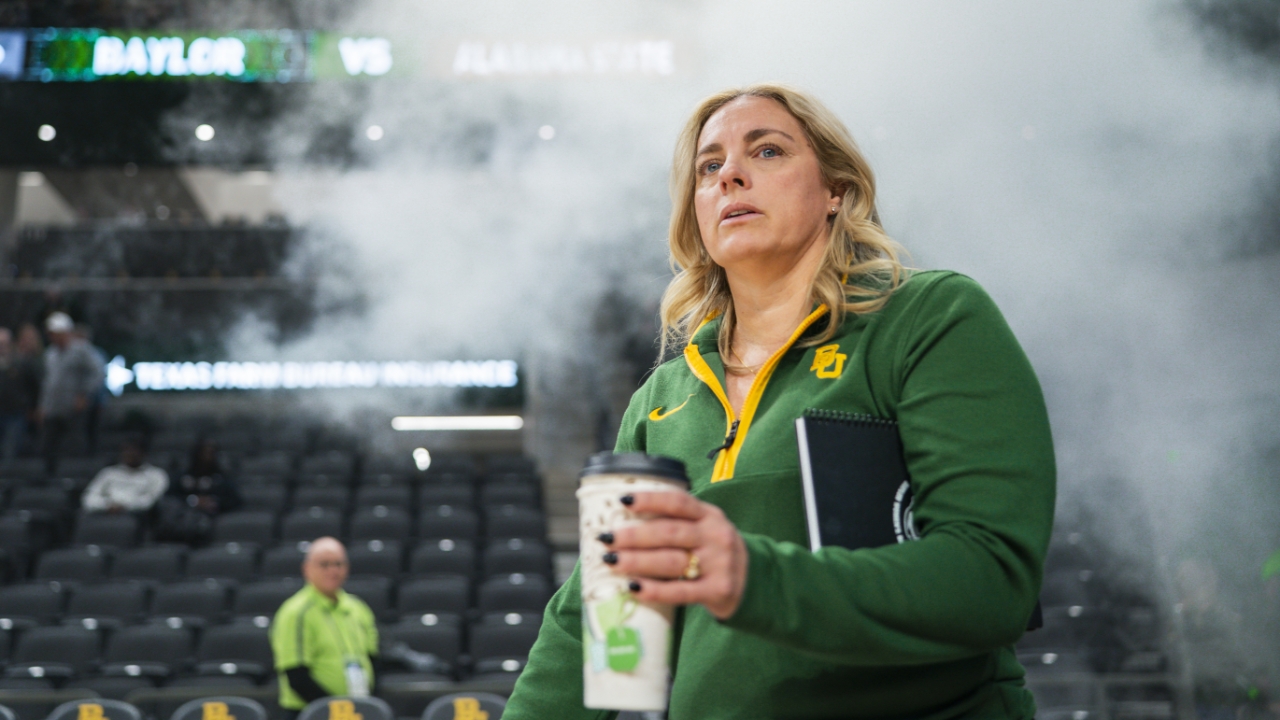
Photo by Jack Mackenzie - SicEm365.com
No. 22 Baylor women’s basketball (11-3, 0-1) has completed its nonconference slate and gotten its feet wet with Big 12 play — what has been good and what has to change for the Bears to reach their ceiling?
The Good
1) Barring a setback from her injury, Taliah Scott is on an All-American pace
Taliah Scott’s impact on offense cannot be overstated. PORPAGATU! (I will abbreviate it as PPRG for the rest of this article) is a stat created by Bart Torvik to evaluate a player’s offensive impact. Scott has one of the better PPRGs nationally, despite PPRG being a metric prone to being skewed by surrounding offensive talent. Examining Scott’s PPRG in the context of Baylor effectively showcases her offensive impact. The redshirt-sophomore guard has a PPRG of 6.8 — the next-highest on the team is 2.7, from Yuting Deng. Every Bear other than Scott is between 0.0 and 2.7, which makes her already strong 6.8 PPRG (18th nationally) even more ridiculous.
Moving to some counting stats, Scott ranks second in the Big 12 and 13th nationally in points per game, despite her average falling from 23.8 points to 20.8 following two short outings against Texas and Texas Tech due to injury. Her consistency has been unbelievable, scoring 20 or more points in nine of the 11 games she played unhindered. Furthermore, she has a career-high 3.5 assists per game, again despite the two injury-shortened games.
Normally, it is hard to be efficient while carrying a large offensive load for a team, but Scott’s ability to score is simply incredible. At the time this is written, there are 67 players nationally with a 30.0 usage rate or higher, and Scott is one of just five from that group with a 64.0% true-shooting percentage or higher and one of just four with an offensive rating above 119. She is just one of three players to fit into both of those groups with fellow All-Big 12 candidates S’Mya Nichols of Kansas and Audi Crooks of Iowa State.
Scott is shooting a blistering hot 72.2% at the rim, a respectable 35.5% in the mid-range and an impressive 39.3% from downtown. She is notably 11/18 on corner 3-pointers. Her efficiency at the rim ranks in the 88th percentile and is even more impressive considering she is a 5-foot-9 guard. Both her rim efficiency and 3-point efficiency are career marks. Her shot selection is also respectable — 70.2% of her shots come at the rim or beyond the arc, and only 18.1% come from the mid-range. While my analytics-loving mind would prefer fewer mid-range jumpers, the shot is key for most stars as defenses key in on their drives.
While Scott’s efficiency does fall against top-50 competition to an alright 52.2% true-shooting percentage, her usage rate spikes to 35.2, making her efficiency harder to maintain. In four high-major games, she is 3-of-7 at the rim and 10-of-27 inside the arc. Due to a lack of consistent shooters around her, teams consistently collapse around Scott, knowing she is the only elite shot creator on the roster. Her 44.3% effective field goal percentage against high-major teams is not good, but it remains higher than the team’s disappointing 38.9% effective field goal percentage in those games. A big reason she remains efficient is her strong 53.8 free-throw rate, up from 28.3 in her 2023-24 season, coupled with her 91.3% free-throw percentage.
Despite her efficiency dropping, her impact against those teams remains strong. Using hoop-explorer’s RAPM metric (a metric that attempts to give team margin credit to players; note that all RAPM references in this article are referring to the version hoop-explorer uses), she holds a 10.4 against top-50 competition. RAPM is another metric that is skewed by surrounding players, and nobody else on the team is above 6.3, with Deng again being second. It should come as no surprise that Scott leads the Bears in adjusted on-off as well. Baylor is 14.1 points per 100 possessions better with Scott on the floor as opposed to on the bench. Against top-50 competition, she ranks second on the team with an 11.2 on-off differential per 100 possessions.
A big reason for this impact is Scott’s ability to affect the game in multiple ways. While her scoring ability will always headline her game, and for good reason, Scott has been arguably the team’s best playmaker and a good defender throughout the season. She is the only player on the roster to have a higher assist rate than turnover rate against top-100 competition and is second on the team in assist rate despite having the fourth-lowest turnover rate on the team. On the other side of the court, she ranks tied-second on the team in DPPRG and DRAPM with Bella Fontleroy.
Scott’s recent injury is a huge question for the future of this Baylor team. She had her first two college campaigns cut short after just 20 and three games. While the recently suffered ankle injury is not season-ending, and the star guard was able to play two minutes in the Bears' last game, Scott operating below her full ability will drop Baylor’s ceiling quickly.
2) Baylor’s defense has done an exceptional job of forcing low-percentage shots
Baylor’s shot defense is one of the most impressive in the country. The Bears rank sixth nationally in effective field goal percentage, holding opponents to just 0.732 points per field goal attempt. Only Texas averaged over 1.00 points per field goal attempt. Furthermore, due to the shot defense, only Texas scored over 1.00 points per possession. Baylor notably held Iowa’s 11th-ranked offense to just 0.841 points per possession and smothered Duke’s 29th-ranked offense to 0.735 points per possession.
A key reason Baylor has been an elite shot defense is the regions Baylor coaxes its opponents to shoot from. Only 21.3% of opponent field goal attempts are at the rim, 9.4% below the Division-I average of 30.6%. The Bears have forced opponents into shooting 50.5% of shots from the deep paint or the mid-range, the two most inefficient regions on the floor. Teams are just scoring 0.601 points per field goal attempt in the deep paint and mid-range, an impressive number. Baylor ranks first nationally in forced mid-range plus deep paint rate per hoop-explorer.
Furthermore, teams are shooting a subpar 54.0% at the rim. Baylor’s 3-point defense has been the strongest data point among the regions. The only team to make over 40% of their shots from deep against the Bears was Lindenwood, and Baylor ranks sixth nationally with a 23.4% 3-point percentage allowed, holding teams to 6.5% below the average on above-the-break 3-pointers and 9.2% below the average on corner 3-pointers.
Baylor’s success in forcing shots from inefficient areas of the floor has held against high-major teams. In four high-major games, Baylor has influenced teams to shoot 24.7% of their shots from the deep paint and 22.0% from the mid-range. The Division-I averages in frequency for these areas are 20.3% and 14.7%, respectively. Opponents have shot 31.3% from the deep paint, 6.8% below the Division-I average, and 33.3% from the mid-range, 1.7% above the average. While the latter is above the average, the shot is still relatively inefficient and backs how Baylor’s defense has pushed teams into shooting from inefficient areas.
Head coach Nicki Collen and company deserve a lot of credit schematically for forcing teams into the mid-range and deep paint. Baylor has also continued to limit opponents from beyond the arc, as high-major teams are just 17-of-66 from deep in the four-game sample. The only nitpick is that the allowed field goal percentage at the rim increases to 58.9%, but that is easily overshadowed by the rest of the percentages and the allowed location frequencies. Baylor is in the 93rd percentile in effective field goal percentage against when facing high majors.
Baylor has done a great job preparing for each team. I would assume this is a huge reason they have varied ball screen coverage throughout the year, as they have used switching, hedging, level and soft drop coverage at different points in the season. As a result, it can be hard to prepare for Baylor, as the Bears customize their defense to their opponent. I have not seen many teams do this, but for example, Baylor switched ball screens against Louisiana Tech and Grambling State after playing more level and soft drop coverage in Orlando against Iowa and hedging against Duke, all in November.
A byproduct of Baylor forcing shots away from the rim is the low free-throw rate allowed. Baylor has allowed a 20.9 free-throw rate against, which is in the 93rd percentile. The number has stayed at a solid amount against high majors as well, only allowing a 25.4 free-throw rate against.
The main reason Baylor is able to force teams into shots between the 3-point line and the rim is the scheme and the length inside. Forwards Kiersten Johnson and Kyla Abraham have been great rim deterrents throughout the year, both posting block percentages over 9.0%. Abraham has posted impressive on-court metrics, with high-major teams shooting just 46.9% at the rim with Abraham on the floor. The two-big lineup with both Johnson and Abraham has kept teams to 4-of-12 shooting at the rim this season, and was a big reason the Bears triumphed over Duke.
I cannot move on from giving the defense its props without giving credit to Fontleroy and Darianna Littlepage-Buggs. The former is who I consider the best defender on the team, due to her motor and deflection creation. Fontleroy is one of just 23 players nationally who currently have a 4.5% block percentage and 3.5% steal percentage. Teams are also just scoring 0.7 points per field goal attempt with her on the floor, as opposed to 0.782 points per field goal attempt with her off the floor. The only downside to Fontleroy’s playstyle is that she is frequently in foul trouble, but any coach will live with some fouls to allow her to create chaos. Littlepage-Buggs leads the team in DPPRG and DRAPM. A big reason for her strong impact metrics is her ability to snag defensive rebounds, which is a unique skill on the team. Littlepage-Buggs ranks 87th nationally in defensive rebound percentage, and her 23.6% defensive rebound percentage is 7.0% higher than anyone else on the team, with Fontleroy ranking second with a 16.6% defensive rebound percentage. While I do want Johnson and Abraham to provide more defensive rebounding, their low percentages are partially a result of them going for blocks.
3) Deng’s emergence gives Baylor offensive hope
After averaging just 4.0 points per game over her first five games with the Bears, the sophomore Deng has scored 11.1 points per game over the last nine, highlighted by a 22-point outburst in Baylor’s recent loss to Texas Tech. She has shot 15-of-25 from inside the arc and 20-of-42 from 3-point range. She is easily the best 3-point shooter on the team with an effortless release.
Deng is also second on the team in offensive RAPM and, as previously mentioned, PPRG. Her offensive impact, whether she is scoring or not, is large due to her gravity as a shooter, causing help defenders to hesitate in their decision-making. Baylor is scoring 0.144 more points per field goal attempt against high-major teams with Deng on the floor versus off the floor. Baylor has also scored 0.118 more points per possession with her on the floor against those opponents. Deng ranks second on the team in RAPM against top-50 opponents and first on the team in ORAPM against said opponents. The wing is one of just two players on the team who have a higher RAPM against top-50 competition as opposed to teams worse than 50th nationally.
Deng’s last game included two off-dribble 3-pointers, a mid-range pull-up after attacking a closeout and a steal to finish through contact. Baylor has lacked shot creation outside of Scott all year (which I will touch on next), but Deng has the ability to create for herself. She is second on the team in off-dribble 3-pointers, and 13 of her 22 2-point makes have been unassisted. She also ranks first on the roster in points per off-dribble 3-pointer, with 1.18 points per shot.
Furthermore, she is 10-of-11 on layups, in addition to being well above the Division-I average efficiency in every zone. Deng is 7-of-8 at the rim, 9-of-18 in the deep paint, 6-of-11 in the mid-range, 15-of-30 from 3-point range in the corners and 7-of-18 on above-the-break 3-pointers. As mentioned previously, Deng’s gravity is huge for the offense. She leads the team in points per catch-and-shoot 3-pointer with 1.24 points per shot.
Deng is not a great defender. She is ninth on the team in DRAPM, seventh in DPPRG, and honestly does not have the defensive motor that fuels great defenders; that is apparent watching her. An interesting note, however, is that she has been metrically better defensively against better competition. While other players on the team are stronger defensively, this Baylor team’s offense has to be more than Scott to be able to compete with the current Big 12 favorites and top-20 caliber teams nationally, and that requires Deng in a sizable scoring role. Her recent flashes as a consistent second or third option raise Baylor’s ceiling.
The Bad
1) Baylor has a severe lack of shot creators
While the Bears do have one of the best scorers in the country in Scott, the rest of the roster has been lackluster in supporting the star from an offensive standpoint. Scott is in the 96th percentile in unassisted field goal makes per game with 3.5. Removing putbacks, Deng is the only other player on the roster averaging over one unassisted made field goal per game. Scott is the only player over 1.0 against high-major teams when removing putbacks, making 3.3 per game, even with her two shortened games being in that sample size.
While these metrics say only so much, it is not hard to see that Baylor lacks players who can beat defenders off the bounce. Outside of Scott, Baylor has done a poor job of attacking closeouts and getting to the paint. Against non-high-major teams, Baylor has had little issue getting downhill, but against high-major talent and athleticism, the Bears’ offense has failed to produce high-quality shots due to a lack of shot and advantage creation. Advantage creation is the ability to take advantage of mismatches.
Style metrics further back the eye test. Against teams outside the top-50, Baylor has gotten into drive-and-kick scenarios 15.9 times per 100 possessions. The Bears have averaged 1.01 points per possession in that scenario, a strong number. While Baylor is actually more efficient on drive-and-kick scenarios against top-50 teams, scoring 1.06 points per play on drive-and-kick 3-pointers, they have only produced that shot in 10.3 possessions out of 100. 10.3 per 100 possessions ranks in the 18th percentile in frequency.
When a team is unable to penetrate and collapse a defense, they have to be able to hit off-dribble jumpers, which are already inefficient shots. It is very hard to be efficient when a team cannot force a defense to rotate and chase and close out hard on spacers. Only three Bears have made off-dribble 3-pointers this season, and only two have against top-50 opponents. Deng is notably the only player to score over 1.00 points per off-dribble jumpers, 3-pointers and mid-ranges combined, against high-major teams. Scott is the only player to score more than 1.69 points per 100 possessions on drives this season, adding to the worry regarding the lack of shot creation.
While Fontleroy, Jana Van Gytenbeek and Marcayla Johnson have provided some downhill pressure in the four games against top-50 teams, none have been efficient against high-major talent. They have scored 0.52 points per play, 0.50 points per play and 0.27 points per play on rim attack scenarios.
I want to talk a little more about Johnson. She does a lot of things well and knows how to get open off the dribble, but she has struggled to be efficient, with a simply awful 37.6% true-shooting percentage. Johnson is 11-of-14 at the rim and 8-of-19 from the deep paint, both strong marks, but her high usage from the perimeter as an underdeveloped jump shooter has really downed her efficiency. She is in the 93rd percentile in mid-range frequency while shooting 25.9% from the region, and has only managed to knock down four of her 27 shots from downtown. Johnson has found a sizable role due to her motor and defensive intensity, and she has solid defensive impact metrics to back that, but she does rank as the team’s worst offensive player by multiple metrics. Johnson either has to play to her strengths and focus more on getting to the rim or improve as a shooter. The potential to be a good shot creator is visible, but Johnson is not ready to carry as big a scoring role as she has tried to take on.
The team has only averaged 0.666 points per field goal attempt with under five seconds on the shot clock against high-major teams, and only 0.778 points per field goal attempt as a whole against those teams. The way to offset underwhelming half-court offense is to get into transition, but Baylor has been limited in transition against equal or better athletes.
The Bears have scored 13.9 transition points per game against non-high-major teams and have scored an extremely efficient 1.40 points per transition possession. However, against high-major teams, while the Bears still score 1.03 points per play, they have only averaged 4.3 points in transition per game. They have failed to turn teams over at a healthy rate and have struggled on the defensive glass.
To truly compete for a Big 12 title, which should be the yearly expectation, Baylor has to find new ways to score schematically, as there is not enough shot creation and advantage creation on the roster.
2) Baylor’s veterans have taken a step back
Littlepage-Buggs and Fontleroy have been cornerstones of the program, and there was optimism that both would build on the foundation they had established at Baylor. However, both seniors are posting career-low effective field goal percentages, and Littlepage-Buggs has her lowest PPRG.
Both forwards are also having career-lows in efficiency against high-major opponents. Littlepage-Buggs is 11-of-36 and has only attempted six shots at the rim, and Fontleroy has been even more disappointing, only converting on 5-of-30 attempts, and has yet to knock down a 3-pointer on 14 attempts.
Littlepage-Buggs has stayed efficient at the rim, only dropping from 73.9% last season to 69.0% this season, but her rim rate has dropped as her deep paint has risen. Her efficiency in the deep paint has been similar, but her mid-range has fallen 7.8%. I believe her mid-range percentage will improve, but her drop in efficiency against high-majors is a lot more worrying, as that did not exist last season.
Fontleroy has been historically streaky, but her inconsistency has reached a new level through the first half of this season. She has either scored five or fewer points or 20 or more points in 12 of Baylor’s 14 games. This year has also continued a trend of Fontleroy regressing from 3-point range. The forward's best offensive season came as a sophomore, highlighted by 27-of-63 shooting from the corners. She was also 45-of-65 at the rim, and an overall 36.4% from beyond the arc. Her efficiency from the field actually improved in games against high-major teams, going from 1.096 points per field goal attempt to 1.102. After being such a lethal shooter from the corner as a sophomore, she only attempted 34 as a junior and only converted on 10. While she maintained elite rim efficiency, her dip in 3-point percentage on high usage dropped her overall efficiency significantly. Her shooting stayed similar against high-major teams. Fontleroy has already made 10 corner triples this year, but has continued to be underwhelming on above-the-break 3-pointers, currently shooting 21.4% on 42 attempts.
Van Gytenbeek has also been underwhelming as a scorer. She was never going to be a high-usage shooter and has been positively regressing to the mean as a 3-point shooter, but her inability to be effective inside the arc, as well as her passiveness to shoot, has hurt Baylor’s offense.
The bigger issue with the offense continues to be turnovers, as the issues from turnovers also hurt the defense. Van Gytenbeek has posted a 37.6 turnover rate in six games against top-100 teams, which is simply way too high. Littlepage-Buggs has also regressed with her playmaking and ball security. After an extremely promising conference play run last year, which saw the forward post an 18.0 assist rate and 12.6 turnover rate, Littlepage-Buggs has posted a 13.0 assist rate and 24.8 turnover rate through this point in the season. Abraham has also continued to have serious struggles with turnovers, leading the team with a 37.6 turnover rate across all games.
Baylor has turned the ball over on 27.6% of their possessions in high-major bouts this season, and that has led directly to opposing points. The Bears have held those teams to just 36.0% shooting from 2-point range and 13.8% from 3-point range, but have struggled to stop teams in transition. High-major teams are shooting 62.2% from 2-point range and 50.0% from 3-point range in transition. Baylor has to limit turnovers to not only help its offense but also help its defense.
There is optimism for all three to improve, as we have seen better offensive versions of all three players, but that needs to start occurring sooner rather than later. The upcoming two weeks will say a lot about the team’s veterans, as they have an immediate chance to prove they are capable offensively against high-major teams with conference play hitting full swing.
3) Baylor has not added a resume-building win since Duke
Baylor opened the season with a strong win against Duke. Despite being 7-6, the Blue Devils are still ranked high metrically and provide Baylor with 0.84 wins above the bubble. However, the Bears have failed to capitalize on three resume-building wins since, falling to Iowa, Texas and Texas Tech.
The Texas loss is excusable — the Longhorns are arguably the best team in the country. However, the margin and fashion of the 35-point defeat were embarrassing. Baylor turned the ball over on 40.1% of their possessions and looked simply unprepared and outmatched in every way.
Iowa and Texas Tech, on the other hand, were missed opportunities. In both games, Baylor led its opponent with under six minutes to go but failed to close because the offense became stagnant.
Baylor currently ranks 24th in wins above bubble, with 1.5. However, the three-game losing streak in Quad-1 games makes that number feel smaller and provides reason for concern. The Bears play two top-40 opponents this upcoming week, and Collen needs to have Baylor prepared to overcome inevitable second-half adversity and notch another Quad-1 win.
Never miss the latest news from SicEm365!
Join our free email list