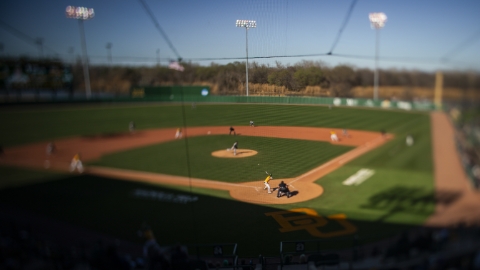
As Baylor baseball wraps up non-conference play and opens Big 12 competition this weekend in Waco against West Virginia, I’ll share my overall opinions on head coach Mitch Thompson’s 2026 squad and discuss my thoughts on what this team, as well as the pitching staff and the lineup, have shown so far, roughly a month into the season. Feel free to agree or disagree with my early assessments in the comment section below!
Breaking Down the Numbers
With the brief introduction out of the way, let’s jump into the numbers, starting with RPI, strength of schedule and things of that sort.
Entering the spring, I went through each game on the schedule to tally wins and losses, and heading into conference play, I gave the Bears a realistic record of 9-7 and an ideal record of 11-5. Baylor’s current record of 10-6 is technically right on track, but it would have been great if the Bears could have held on to late leads against Purdue and Tarleton State.
Before D1Baseball opens up its RPI tracker in the next few weeks, we have to solely rely on Warren Nolan, and as a caveat, these early-season analytics can still be a bit volatile until teams get squarely into their season and put a few conference series under their belts. The good news for Baylor is that it shouldn’t get beaten up too badly if it were to lose a series to either of its first two opponents in Big 12 play: West Virginia or Oklahoma State.
As of the time of writing this on March 11, the Bears sit comfortably at 30th in the nation in RPI, which ranks fourth in the Big 12 behind — Cincinnati (5th), West Virginia (19th), Oklahoma State (22nd), UCF (23rd) — and has faced the 22nd toughest strength of schedule, the third-highest in the Big 12, trailing only Cincinnati (16th) and UCF (11th).
It should go without saying, but this is clearly the highest mark in both RPI and SOS of Thompson’s tenure, and it’s paid off playing some really solid ballclubs in both the Round Rock Classic — Oregon State (18th), Purdue (60th), Southern Miss (1st) — and the Bruce Bolt Classic: Ole Miss (11th), Texas (4th), UTSA (9th).
As of this time last year, Baylor’s RPI was 109th in the country with the 217th SOS; the Bears’ RPI reached as high as 37th following the road series win over ranked Arizona, but rapidly fell back down after series losses to Houston and Texas Tech.
A month into the young 2026 season, the biggest difference between Baylor (1-6) and the Big 12 teams ahead of it in the RPI is their records against Quad 1 and Quad 2 opponents: Cincinnati (7-4), West Virginia (7-3), Oklahoma State (1-1) and UCF (2-3).
While it’s still probably too early to tell, it would appear the top-end of the Big 12 isn’t as strong as previously predicted, and the Bears most definitely control their own destiny in terms of making the NCAA Tournament for the first time since 2019.
Baylor’s schedule features some big tests, both at home against West Virginia and TCU, and on the road against Oklahoma State, Cincinnati and Arizona State. Pancaked in the middle of the schedule, however, are two very winnable series against BYU and Houston. Plus, I really like how the end of the season shapes up if the Bears still have something to play for in May, as they will face both Texas Tech and UCF at home, with the last series of the year on the road against Utah.
While my preseason record prediction was 29-25 (13-17), Warren Nolan currently projects that Baylor will finish the season 27-27 (11-19). Although there are some really difficult series on the docket in conference play, it’s also a time for huge opportunities, and if the Bears can stay healthy and get to that 15-17 win-range in conference play, then I think they should have a good chance to be in that bubble conversation heading into the Big 12 Tournament.
Getting to, and perhaps even exceeding, 15 wins in conference play will be no easy task; whether this relatively young squad can get there remains to be determined. I think we’ll get a much better idea of what this team is made of, especially the batting order, after this next seven-game stretch against West Virginia, Kansas State (midweek game that doesn’t count toward Big 12 record) and Oklahoma State.
Early Season Pitching Takeaways
I’ve remained consistently bullish on this group throughout the first month of the season, mostly because I trust that second-year pitching coach Sean Snedeker is going to get the absolute most that he possibly can out of his unit.
So far, that’s proved true, despite the pretty difficult schedule the Bears have faced, as they sit seventh in the Big 12 in earned run average (4.04), while issuing the third-fewest amount of walks (48) in the conference; they also sit toward the middle of the Big 12 in WHIP (1.39) and strikeouts (134). Although the batting average against (.270) is a bit concerning, hopefully that can be chalked up to facing teams such as Oregon State, Southern Miss, Ole Miss, Texas and UTSA.
While I don’t believe this is an elite, top-of-the-conference-quality unit, I think it’s above average and should be more than serviceable for the rest of the spring. The one area where I think the Bears are markedly better than last year is the weekend rotation. If everyone stays healthy, and that truly is the key, then I believe there are enough options to at least give you a chance on any given Friday, Saturday or Sunday.
This veteran group of strike-throwers won’t overwhelm you with velocity, but each possesses an ability to command the zone and get outs. Excluding Ethan Calder (2.16 ERA, 1.26 WHIP, .242 B/AVG, 16.2 IP), who has made all four of his scheduled starts, the concern with this group is injuries: Lucas Davenport (0.00 ERA, 0.90 WHIP, .136 B/AVG, 6.2 IP) missed back-to-back starts, and Stefan Stahl (0.87 ERA, 1.06 WHIP, .211 B/AVG, 10.1 IP) missed last weekend’s outing against Air Force. That’s a pretty salty group, if everyone’s available, but that’s obviously the million-dollar question as conference play kicks off.
If the Bears are in a pinch, Thompson could also potentially turn to Rowan-Gloucester sophomore transfer Zack Wallace (0.63 ERA, 0.77 WHIP, .191 B/AVG, 14.1 IP) or DBU junior transfer Charlie Atkinson (2.53 ERA, 1.50 WHIP, .279 B/AVG, 10.2 IP), both of whom have been really solid out of the bullpen.
It’s not all good news with the pitching staff, however, as Wisconsin-Whitewater transfer Cade Hansen (Sr.) seems to be trending in the all-too-familiar path where enormous success at lower levels doesn’t necessarily translate to Division I.
Similar to how Hendrix transfer Bryson Bales flamed out early last year and became unusable by Big 12 play, Hansen (10.67 ERA) has struggled through five appearances (14.1 IP), surrendering a team-high 23 hits, 17 earned runs and seven free passes. Hopefully, Hansen can still prove to be serviceable in limited capacities, but it’s pretty clear that he probably shouldn’t be a starter moving forward.
The second blow is the fact that lefty Mason Green (Jr.) has been shut down for the season with an arm injury, following just three appearances out of the bullpen. I expressed in the weeks leading up to the season that I believed Green was the most electric arm on the roster, but the key with him was staying healthy, as he missed half of last year with an injury.
Upon return last season, Green had some special flashes, but then went on to miss the fall with an injury as well. I mostly viewed him as a question mark going into 2026, so it was probably unwise to ever expect him to be a major player this year with his injury history, but without him, the ceiling of the pitching staff probably goes down a decent bit.
As for the bullpen, this group has impressed me with all of the new faces. Without All-American closer Gabe Craig on the roster, the backend of games will naturally be an adventure, but you at least have two veterans in Caleb Bunch (1.69 ERA, 0.94 WHIP, .194 B/AVG, 10.2 IP) and Grayson Murry (4.50 ERA, 1.80 WHIP, .333 B/AVG, 10 IP) that you believe you can trust back there, although you’d like Murry to be a little sharper.
I’ve liked what I’ve seen from the freshmen Brayden Bergman (0.00 ERA, 1.62 WHIP, .294 B/AVG, 4.1 IP), Luke McLeod (0.00 ERA, 1.20 WHIP, .286 B/AVG, 6.2 IP) and Caldwell McFaddin (0.00 ERA, 0.50 WHIP, .077 B/AVG, 4 IP) in limited opportunities.
For this group to be at its best, though, Snedeker needs some of the middle relievers — Cayden Baker (7.88 ERA, 1.50 WHIP, .290 B/AVG, 8 IP), RJ Ruais (3.52 ERA, 1.30 WHIP, .290 B/AVG, 7.2 IP) and Luke DeVasher (6.75 ERA, 1.50 WHIP, .276 B/AVG, 8 IP) — to be really solid.
On a closing note, defensively, this is probably the best the Bears have looked under Thompson, and it’s mostly because of the upgraded athleticism in the corner outfield spots with Brady Janusek (Fr.) manning right field and Hunter Snow (RFr.) in left field, as opposed to Wesley Jordan and Enzo Apodaca last season, neither of which were plus-defenders.
At first base, Tyce Armstrong (RSr.) is a revelation compared to what Baylor had for the majority of the time there last season, and third base play has improved for the most part, with Brytton Clements (RFr.) and Cade Dodson (So.) splitting time at the hot corner.
Baylor’s currently fifth in the Big 12 in fielding percentage (.976), and the middle infield duo of Travis Sanders (RJr.) and Pearson Riebock (So.) has helped power the Bears to a league-high 16 double plays.
Baylor’s totaled 14 errors through 16 games, with two of those coming from pitchers on pickoff moves, and seven of the miscues coming in the two games in Houston against No. 25 Ole Miss and No. 3 Texas. At this point last year, Baylor had totaled 20 errors.
Early Season Offensive Takeaways
While I’ve spoken pretty positively about the pitching staff and the defense, the lineup is where my major concerns remain for this team as it heads into conference play. Before we get into the specifics, let’s talk about the positives, and it starts with Sanders at shortstop and Janusek in right field, as these two players have been absolute studs to start this spring.
Both Sanders and Janusek have reached base safely in all 16 games. Sanders leads the team in multi-hit games (8), batting average (.413), on-base percentage (.519) and extra-base hits (9). Janusek is not far behind in the same categories — batting average (.344), on-base percentage (.459) and extra-base hits (8) — while leading the team in runs scored (17).
Armstrong has cooled off following his incredible Opening Day that featured three grand slams, but is still performing about where he was expected to be, as he leads the team in home runs (6) and RBIs (24) and boasts a .300 batting average and .427 on-base percentage. Both Armstrong and Janusek are tied for the team lead in total bases (38).
After earning All-Big 12 Freshman Team honors a season ago, Riebock is off to a slower start than one would like to see, as he’s hitting .250 with a .455 on-base percentage, but he missed four games with an injury and is hopefully getting back up to speed.
Now, let’s talk about some of the issues. As I mentioned previously, these stats can be a bit skewed this time of year when comparing to other teams, considering the schedule the Bears have played, and while it’s true that Baylor has faced some really quality pitching, I’d still contend the quality of at-bats leaves a lot to be desired.
Heading into conference play, the Bears are in the bottom half of the Big 12 in batting average (.275) and runs scored (107) and have the second-highest strikeout total (163) in the league.
Prior to this four-game winning streak, where Baylor took care of business against Air Force and Sam Houston, the Bears were batting .259 as a team, and in their previous eight-game stretch, which included the Round Rock and Bruce Bolt Classics, they were hitting .216 with runners on and .194 with runners in scoring position. Those numbers drop to .193 and .175 if you were to remove the 9-8 win over Stephen F. Austin on Feb. 24.
Point being, this team, outside of a few players toward the top of the order, has yet to show the ability to consistently hit quality pitching, and that’s a major question mark going into conference play, and will likely be the thing that holds this squad back from reaching their ceiling.
The good news is that the Bears have shown an ability to draw free passes (120) at a high level and are getting on-base at a really solid .411 clip. The issue is that it hasn’t necessarily translated into runs due to problems with situational hitting. This seems like something that could hypothetically be fixed, as we said last year, but it's easier said than done.
So while it’s a concerning trend considering these have been recurring issues dating back to the last few seasons, I haven’t lost all hope because this is an extremely young lineup, especially toward the bottom of the order, and you’d like to think they’d get better with more at-bats.
The one final thing that I’m keeping a close eye on, especially across these next two weekends are what happens in center field and at third base.
Unfortunately, it doesn’t appear that Ty Johnson (5Sr.) will be regaining his 2024 form, as he’s struggled out of the gate, hitting .167 with a .314 on-base percentage across 12 starts. It also doesn’t look like Bo Caraway (Fr.), despite a strong start to the year, looks ready to take the mantle of everyday center fielder.
As Big 12 play begins, will Johnson, who’s still a really solid defender, continue to get the nod in center, or will Thompson have to get creative by moving Riebock or Janusek over?
After leading UTA in nearly every offensive category last season, Dodson has scuffled immensely since transferring, as he’s just 4-for-31 (.129) at the plate this year with 13 punchouts. Unlike center field, Clements has emerged as a legitimate option at third base, hitting .314 with three extra-base hits, which is a great sign, but I’d like to see how he performs against better pitching.
Another positive is that Odessa College transfer Robert De La Garza (Jr.) has started to crack the lineup recently and has been impressive, going 4-for-7 at the plate and has scored three runs. De La Garza should have an opportunity to prove he belongs in the batting order every day.
On a closing note, I wanted to compare last year’s team’s numbers to this team at the start of the conference play. I figured that I would find the 2025 squad to blow the 2026 team out of the water numbers-wise, but I was pretty surprised to find there’s really not that big of a difference, other than a much higher batting-average last year and significantly more strikeouts in 2026. I don’t have a ton of other takeaways with this data, but it’s interesting nonetheless.
- Batting Average: .275 (2026) / .308 (2025)
- Runs Scored: 107 / 123
- Home Runs: 15 / 15
- Doubles & Triples: 32 / 37
- Strikeouts: 163 / 101
- Free Passes Drawn: 120 / 115
- Stolen Bases: 26 / 21
- Strength of Schedule: 22nd / 217th
*Baylor’s offensive stats heading into conference play for 2026 are on the left, and Baylor’s offensive stats heading into conference play for 2025 are on the right*
Overall Thoughts Heading into Big 12 Play
Usually, you’d think that after watching a team play 16 games, you’d get a pretty good idea of the pulse of the program, as well as the ceiling and the floor. This year, however, I’m still struggling with what to make of Thompson’s team, even though we’re a month into the season.
As I try to formulate my thoughts, I think I’ve settled on the fact that this team most definitely has a greater margin for error than in years past because of the options they possess in the weekend rotation, as well as the significant improvements they’ve made on defense, mostly because of the upgrades in the corner outfield and corner infield spots, and lastly, the havoc they’re able to consistently create on the basepaths because of the upgraded athleticism.
The lineup, however, still has its fair share of issues that have plagued this program for the last few seasons, including struggles with runners in scoring position and strikeouts, especially against better competition. The main difference with this year’s team, though, is that they possess a bit more pop throughout the order that hasn’t existed up until this point of Thompson’s tenure, and it’s able to make up for some of the other offensive limitations.
With that being said, that doesn’t necessarily mean I’m completely giving up on this year’s batting order because if they’re able to simply get better with putting the ball in play consistently, I think it has the potential to be a serviceable unit.
However, until I see the Bears do that against quality Big 12 competition, I can’t predict an NCAA Tournament berth at the moment, but I do think if the lineup continues to show signs of improvement and the pitching staff remains healthy, Baylor will have plenty of opportunities in conference play to prove it should be playing in early June for the first time since 2019.