Friday Highs, Weekend Lows: What’s Holding Baylor Baseball Back at the Halfway Mark?
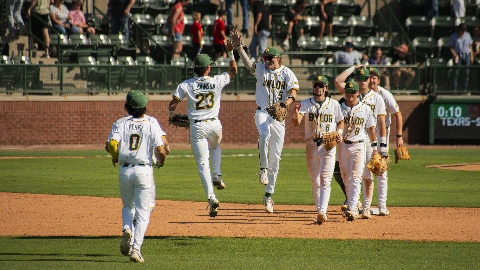
Whether it was the extra-innings win over No. 25 Ole Miss, the back-and-forth victory against No. 22 West Virginia or right-handed reliever Caleb Bunch’s masterful three-inning save versus Oklahoma State, Friday nights have been good to Baylor baseball across the last month.
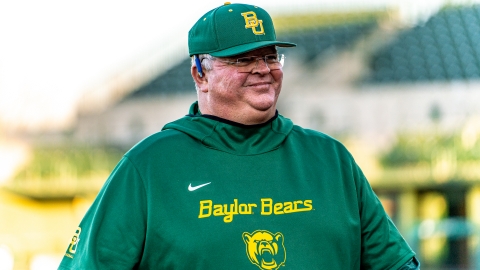
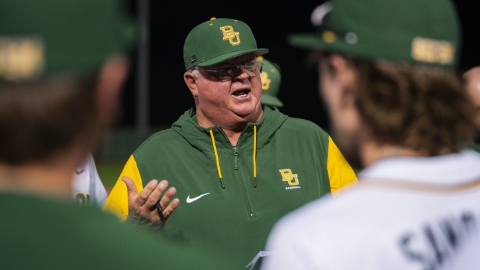
That’s great, one could assume, what incredible progress for head coach Mitch Thompson in his fourth year at the helm of the program. The only problem is that the Bears haven’t been able to build on their thrilling Friday wins and have a 0-6 combined record on Saturdays and Sundays in the Bruce Bolt Classic and the two series to start conference play.
Right when you think this program has turned a corner, and it’s time to get over the proverbial hump, things haven’t gone according to plan, as Baylor has been out-scored in those six defeats, 55-19, only one of which was a run-rule loss.
Granted, one could argue that’s against pretty stiff competition, but in order for this program to take that leap, Baylor has to find a way to turn its Friday-night successes into series wins against quality opponents, and that just hasn’t been the case in 2026, unfortunately.
At the midpoint of the season, the Bears are coming off a 16-7 rout of UIW on Tuesday night, hold a 13-11 overall record and are 2-4 in Big 12 play. Baylor currently boasts a solid RPI at No. 41 in the nation and has faced the eighth-toughest strength of schedule. The Bears have a combined record of 4-11 against Quad 1 and Quad 2 opponents, and are 9-0 against Quad 4 opponents.
The good news is the Bears have an opportunity to make a run for their first NCAA Tournament berth since 2019, and hopefully, stringing together two consecutive strong weekends against Houston and BYU can put them on that path. The bad news is that if they don’t take care of business in these next two series, the meat of the schedule awaits in mid-to-late April, with back-to-back-to-back series against Cincinnati, TCU and Arizona State.
With that being said, what’s it going to take for this team to get over the hump? Is it the pitching staff? Is it getting players healthy? Is it the lineup? Is it getting more experience? Let’s look at each area.
Starting with the pitching staff, the Bears are currently toward the middle of the pack in the Big 12 in most statistics: ERA (5.37), WHIP (1.52), B/AVG (.283) and punchouts (197). The conference-only stats are probably a bit inflated due to Lucas Davenport being limited to seven total innings and Stefan Stahl missing both starts, as Baylor is sixth in ERA (7.38), has the sixth-highest B/AVG (.320) and has issued the fifth-most free passes (32).
With Sean Snedeker’s unit, injuries have really hampered what this group could have been. No, they don’t have many top-end players that are going to dominate opponents and wind up getting selected in July’s MLB Draft, but Snedeker has consistently, over his career, shown that he can squeeze about everything he possibly can out of his pitching staff.
Just look at the turnaround he was able to make last season, where he helped guide the Bears from the last in the conference in virtually every pitching statistic in 2024 to top 30 nationally in BB/9 (3.23, 7th), WHIP (1.33, 22nd), K:BB Ratio (2.57, 27th) and ERA (4.52, 29th) in 2025, and that was with a make-shift weekend rotation.
This season, however, things went south after just three appearances when it was announced that lefty Mason Green, who I believe has the highest ceiling of any pitcher on the roster, would miss the rest of the spring with an arm injury.
On top of that, weekend starters Davenport and Stahl have combined to miss five starts, with Stahl last pitching on Feb. 27. Meanwhile, Davenport had been on a strict pitch limit since returning, and has totaled just nine innings across three starts since being back. Stahl looked special in his two starts against No. 11 Oregon State and No. 25 Ole Miss, as he combined to punch out 11 batters and allowed one earned run in eight innings of work.
Had those three players been in the weekend rotation consistently, and southpaw Ethan Calder been moved back to the middle-innings relief role, which saw him earn All-Big 12 honors in 2024, then that’s a pretty salty unit that would have combined for somewhere close to 20 innings a weekend.
Although veteran righty Grayson Murry (6.91 ERA, 2.16 WHIP, 14.1 IP) has taken a sizeable step back after an elite season in 2025, when he posted a 2.19 ERA with 12 scoreless outings, the Bears still have some solid pieces in the bullpen with Caleb Bunch (1.69 ERA, 1.13 WHIP, 16 IP), Zack Wallace (3.80 ERA, 1.17 WHIP, 21.1 IP) and Charlie Atkinson (3.86 ERA, 1.41 WHIP, 16.1 IP) leading the way.
I don’t say all of that to excuse some of the struggles on the mound, as Wisconsin-Whitewater transfer Cade Hansen (10.50 ERA, 2.11 WHIP, 18 IP), as well as a few other relievers, haven’t lived up to expectations, but I believe this unit had the chance to be a lot better than what we’re seeing had a few key players stayed healthy and been able to eat a majority of the innings in Big 12 series.
This program just isn’t in a position, depth-wise, to sustain a few important arms being sidelined, and as a result, there’s been some really ugly final scores (13-2 WVU on March 14, 8-0 WVU on March 15, 13-3 K-State on March 17) where Thompson and Snedeker had to either wave the white flag relatively early in the contest to save their bullets for another day or there just wasn’t enough in the bullpen to keep the game respectable.
Even then, if Davenport can continue to get stretched out and Stahl returns here pretty soon, which I’m optimistic could be this weekend in Houston, I think a weekend rotation of Davenport-Stahl-Calder is probably the best that Thompson has had in his tenure and should give the Bears a chance on any given day. The major question mark here is health, but I remain as bullish as I can be on this unit, considering the circumstances.
Now, let’s talk about the lineup. This is the group that I was pretty worried about heading into the spring, knowing that they were going to have to replace six starters from last year’s team with a group of relatively unknown commodities.
It’s a limited sample size, but let’s look at where the Bears shape up through six conference games, in comparison to their Big 12 foes: AVG (.218, 13th), OB% (.323, 14th), SLG% (.319 13th), total bases (60, 13th), runs scored (24, 14th) and strikeouts (67, 2nd).
Some of the same issues that plagued Baylor in Big 12 play last year have reared their ugly heads again this spring, as the Bears are batting.241 (21-87) with runners on, .203 (12-59) with runners in scoring position and have a team strikeout rate of 36% (67-188) in those six conference contests.
Maybe West Virginia and Oklahoma State have some of the best pitching in the conference, and those stats are skewed. The numbers, however, don’t change that much when you factor in the entire season as well: AVG (.269, 13th), OB% (.396, 10th), SLG% (.412, 11th), total bases (314, 12th), runs scored (150, 12th) and strikeouts (239, T2nd).
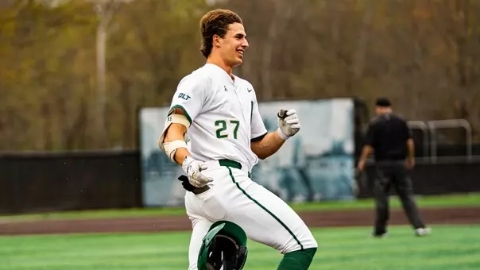
The biggest bright spots have been shortstop Travis Sanders and right fielder Brady Janusek, both of whom have been outstanding and are playing at All-Big 12 levels. Sanders leads the team in batting average (.386), hits (34) and doubles (8), while Janusek is not far behind: .348 AVG, 32 hits, eight doubles and leads the Bears in runs scored (24) and OPS (1.048). Elsewhere, in the lineup, a lot has been left to be desired.
For Baylor to have had a better batting order than it had a year ago, in my opinion, it needed these things to happen: at least three or four unproven underclassmen to be Big 12-caliber players from Day 1, Ty Johnson to regain 2024 form at the plate and for the projected heart of the order — Sanders, Pearson Riebock, Cade Dodson and Tyce Armstrong — to each have above-average seasons.
Instead, Janusek, as well as infielder Brytton Clements (RFr.), are the only inexperienced underclassmen who have proven to be consistent and solid everyday starters, and that’s not a shot at any other players, as a few guys still have a ton of potential; it’s just a tough ask for so many freshmen to immediately be Big 12-ready.
Johnson, although he had his best series of the season last weekend in Stillwater, hasn’t been able to regain his 2024 form and is hitting .215 with a .346 on-base percentage and .308 slugging percentage.
As for the heart of the order, Sanders has been incredible, obviously, but Riebock (.246 AVG, .407 OBP, .273 SLG) broke a finger against No. 3 Texas and has clearly been hampered, although he’s 5-for-13 in his last four games, so hopefully that’s a sign of things to come.
Dodson, after being one of UTA’s best players as a freshman in 2025, had a brutal start to the spring and didn’t stay in the lineup long enough to be able to play through it; he’s currently hitting .205 with a .352 on-base percentage and .250 slugging percentage.
Lastly, Armstrong has understandably cooled off following his historic three grand-slam debut, but he’s still been solid and has met expectations, leading the team in home runs (8) and RBIs (31), while holding a .281 batting average, .400 on-base percentage and .607 slugging percentage.
A lot of things had to go right for this lineup to be pretty good this year, and unfortunately, that just hasn’t been the case as we sit at the halfway mark of the season. There’s still time to turn it around for some key pieces, but this team is going to have to lower its strikeout rate and be better with runners in scoring position against Big 12 pitching.
Now, Baylor enters an interesting inflection point in its season where the Bears will spend the next two weekends playing two ballclubs that they’re markedly better than, on paper, in Houston (13-11, 1-5) and BYU (11-12, 2-4), both of which should – key word: should — be series wins.
There’s no guarantee, though, because even last year, with 2025 being the only season of the Thompson Era when the Bears had a clear leg-up on some Big 12 counterparts, Baylor struggled to take care of business against teams it was better than. The series losses to Houston and Texas Tech come to mind, and I’d still contend flip three of those four losses, and the Bears probably could have had enough momentum to make the NCAA Tournament.
If Baylor can perform up to its potential and win at least four of these next six conference games, ideally five of the six, then you could see the Bears start to stack some momentum going into the back-half of conference play. However, if Baylor isn’t able to take advantage of two of the most winnable series remaining on the ledger, then it could be a drag to the finish line, and it might, unfortunately, turn into another battle just to make the Big 12 Tournament in late May.
I know some people were ready to pronounce this season dead after the series loss to Oklahoma State this past weekend, and I’d be lying if I said it didn’t cross my mind, but I still want to see what this squad is able to do against some of the bottom-feeders of the Big 12. If, after these next two series, Baylor looks like it truly belongs in that bottom tier rather than clearly outperforming teams like Houston and BYU, then I believe it’s reasonable for serious discussions about the program’s future to begin.