Not Just 'Damaged' but Obliterated: Images of US AWACS Jet At Saudi AirbaseImages have emerged revealing that the
Wall Street Journal's initial
report that the half-billion-dollar aircraft was merely "damaged" was an enormous understatement. Rather, a large portion of the fuselage has been obliterated, along with the distinctive 30-foot-diameter, 6-foot-thick rotating radar dome that's mounted atop AWACS aircraft. We took a closer look at the
photo set here.
The images of the destroyed E-3 Sentry were first posted on the
Air Force amn/nco/snco Facebook page:
"The loss of this E-3 is incredibly problematic, given how crucial these battle managers are to everything from airspace deconfliction, aircraft deconfliction, targeting, and providing other lethal effects that the entire force needs for the battle space,"
Heather Penney, a former F-16 pilot and director of studies and research at AFA's Mitchell Institute for Aerospace Studies, told
Air & Space Forces Magazine. If this has been carefully kept under wraps until now, what else is the White House and Pentagon not telling the public?
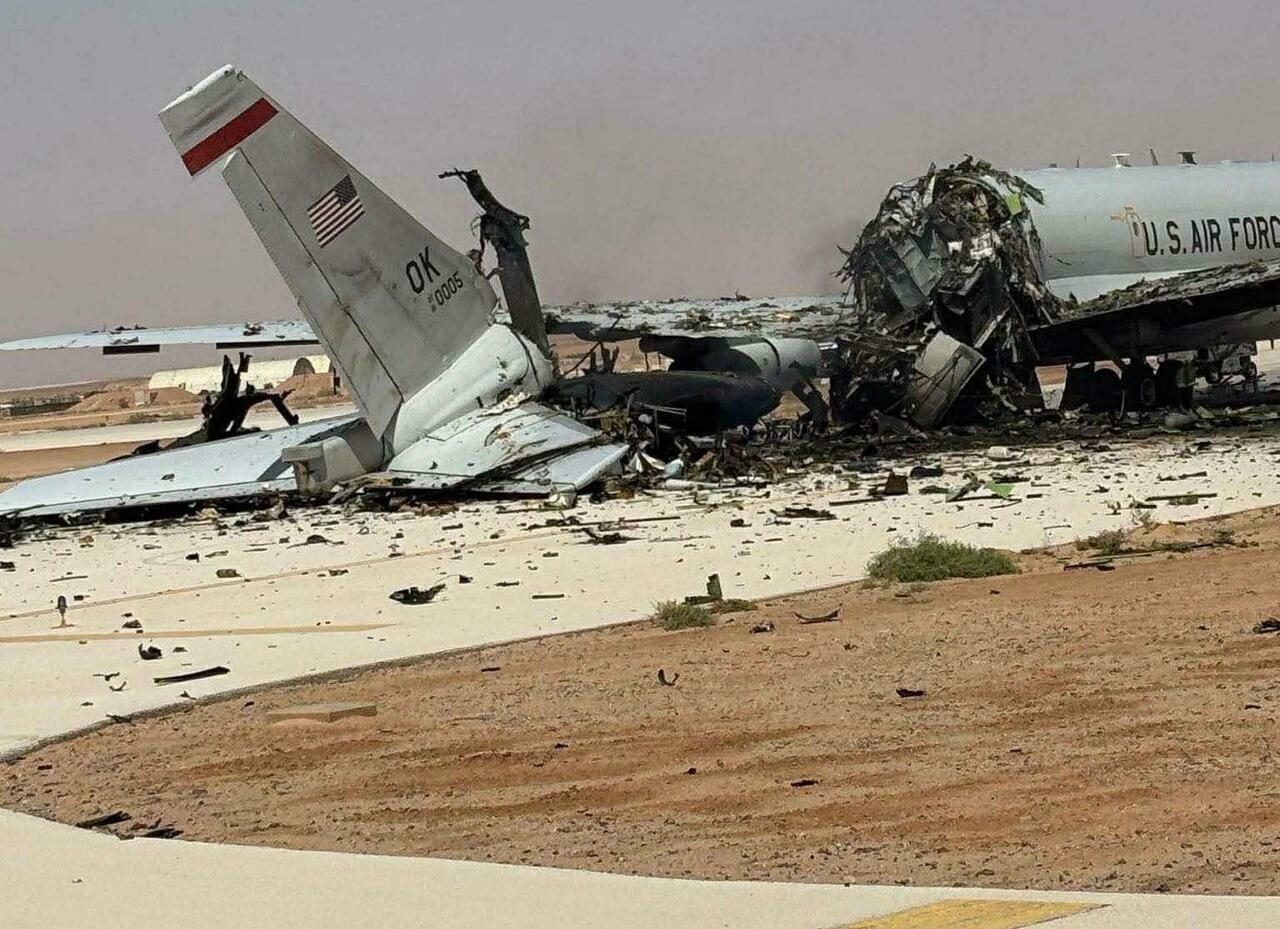
According to military aviation
aficionados, the identifier "OK 81-0005" -- visible on the severed tail -- confirms this particular aircraft was an E-3G named
"Captain Planet," which deployed to the Middle East theater from Oklahoma's Tinker Air Force Base. It's not clear if any of the recently-wounded service members were associated with the aircraft, which was destroyed in a missile-and-drone attack on PSAB.
The destroyed E-3 was one of
six stationed at the Saudi base and only 16 active craft in the entire Pentagon inventory -- and all of them can't even be counted on, on any given day:
Quote:
The E-3 is aging, and its capabilities are falling behind those of some major adversaries. The Air Force's E-3 fleet has dwindled down to 16 as the service retires less-capable planes. In fiscal 2024, E-3s had a mission-capable rate of about 56 percent, meaning a little more than half were able to fly and carry out their missions at any given time. -- Air & Space Forces
Despite its B-list status,
earlier Iranian successes have elevated the E-3 Sentry's importance.
Iran reportedly damaged a $1.1 billion AN/FPS-132 radar at Al Udeid Air Base in Qatar -- one of just six in the world -- and blew up a nearly
$500 million AN/TPY-2 THAAD radar at Muwaffaq Salti Air Base in Jordan. There's reason to believe other radars suffered similar fates, thwarting US detection and response to incoming fire. The radars take years to replace. In the ultimate example of financially-asymmetric warfare,
Iran may have used drones that cost between $10,000 to $30,000 each to inflict some or all of that damage.

