S11 X's and O's Preview: How Auburn, Hugh Freeze Plan to Challenge Baylor
This is part three of my Baylor-Auburn preview, covering the Tigers from a schematic and strategic standpoint. Part 1 covered their statistical trends, and Part 2 covered their roster.
How Hugh Freeze’s Tigers Attack
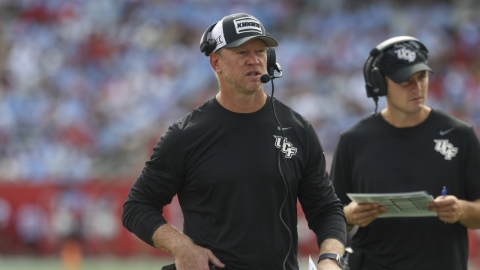
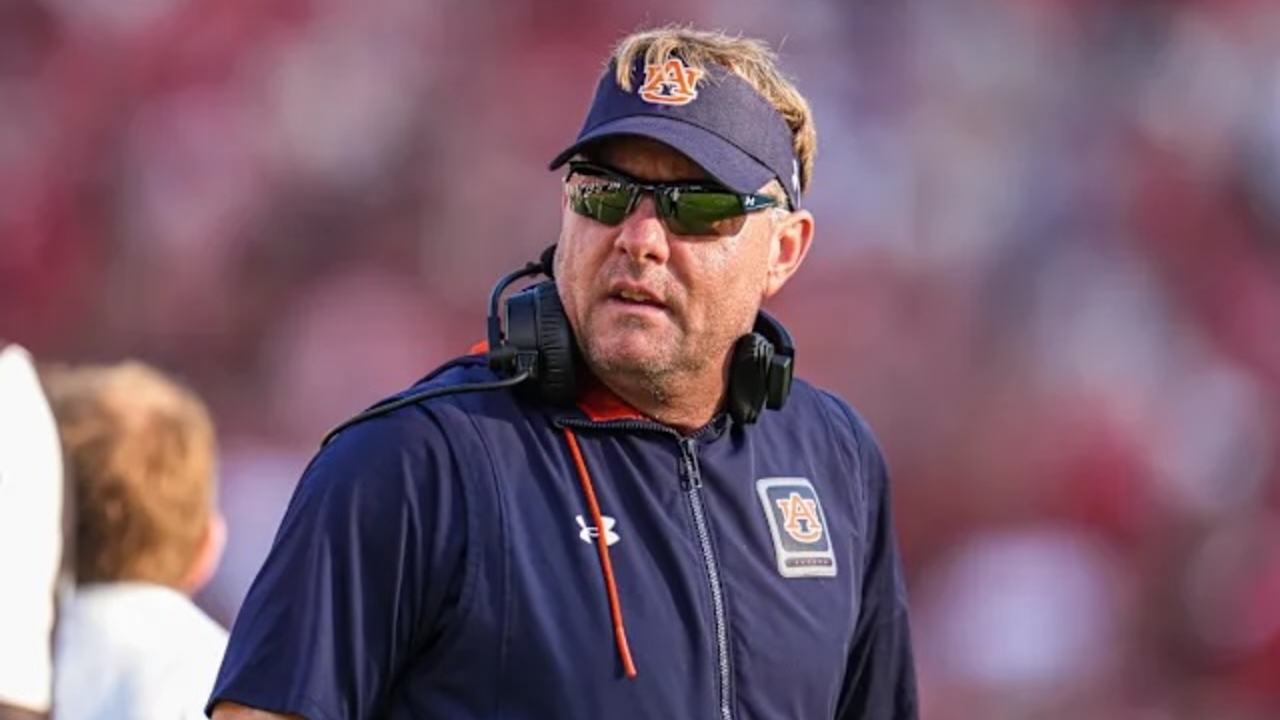
The Tigers are led by head coach Hugh Freeze. He’s a former high school coach who is known for a wide-open and uptempo offense that turned Ole Miss into a top program with back-to-back New Year's Six Bowl appearances and back-to-back upsets of Nick Saban’s Alabama. He also got into trouble there with a recruiting scandal that forced him to reinvent himself at Liberty, where he built that program up and upset Arkansas on the road. He’s also humorously the guy who coached a game from a hospital bed and was the high school coach of Michael Oher, who the movie “The Blind Side” portrayed as a goofy coach under another name.
At Auburn, he has recently been under pressure, with an 11-14 record over the last two seasons, including a 5-11 mark in SEC play. He was hired to bring Auburn back with a wide-open scheme and better recruiting than Bryan Harsin, who struggled to build a roster in the SEC in the eyes of the Tiger boosters. He has a lot of heralded recruits this year, and Tiger fans want to win now.
Offense
This is a spread to run offense that wants to run the ball and packages RPO routes to most of its base run concepts as an origin point for its offense. It’s also going to mix in motion and tempo. Here’s an old explanation he gave former ESPN analyst Trevor Matich during his Ole Miss days.
The offense isn’t limited to this kind of thing, but he wants to take advantage of where he has numbers, much like Briles, Malzahn, Kelly and other spread gurus have. He went on ESPN Radio and even said that old-school Ed Orgeron’s staff would ask wideouts to try to dig out a safety to block for the run game, and to that Freeze sat there thinking “when I get a chance to run an offense I’m not asking that receiver to go block that safety - we’re going to lose that.” He later added, “I still block him, but I block him because we run a route... if he wants to play the run in that box, then we shouldn’t be handing the ball off.”
A basic example of this was a drive from a bowl game against Pitt in his Ole Miss tenure: they ran the same Run+RPO play from the same formation repeatedly to score. Same formation, same personnel, same exact play, but it gave the QB four options depending on where the numbers said they had an advantage. The four options are diagrammed below with the QB potentially handing it off on inside zone, keeping it on a QB read with the TE leading for him, throwing a bubble screen or throwing a hitch to the single side wide receiver.
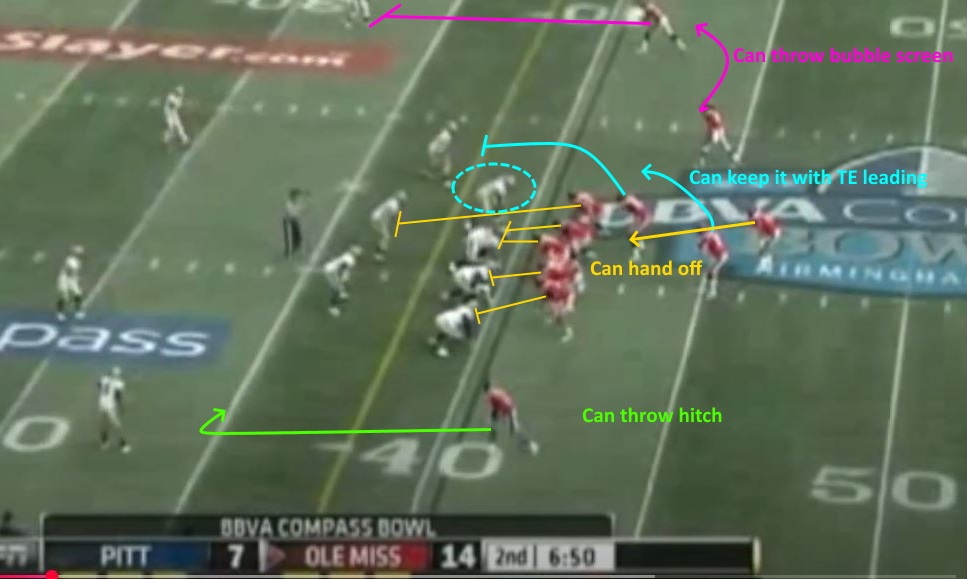 Former Baylor graduate assistant and experienced coach Cody Alexander has a nice video of each play.
Obviously, these are old clips, and the offense has evolved from this to some degree, but the mentality is ingrained in much of what they do, and the willingness to option-read with the quarterback and use RPOs on most of their run concepts remains extremely common in his offense even today.
"I will never change what we do offensively. I don’t know all, but what we’ve done has had success everywhere we’ve been. It’s what I am familiar with and what I feel comfortable calling the game with, so we’re doing the same stuff." -- Hugh Freeze on the show "Tennessee Two-A-Days"
They do a lot of solid things with changing tempo and using pre-snap motion. It’s going to do a lot of little things to stress the defense.
On the ground, they’ll use zone schemes and gap schemes. I’ve seen them use inside zone, wide zone, power, counter, frontside trap and other gap schemes like duos. They will incorporate QB reads into their base schemes to add further stress to the defense.
Sometimes it’s a typical QB read with the tailback running their usual zone, power, counter, or other base scheme, and the QB optioning someone with the option to keep it outside, as we’ve seen countless teams use. However, Auburn has frequently been using BASH reads into their runs where it’s blocked for the QB, but a sweep for the back is an option to hand off away from the interior run design.
As mentioned before, they do a lot with RPO concepts, and according to one SEC data site, the RPO constituted around 29% of the offense with
The passing game has a decent dropback game featuring some basic concepts like four verticals, flood concepts, spacing and double moves. Here, they torched Alabama for a score after making a double move look exactly like a mesh sit.
They also have a solid play-action game and do a decent job scheming up shot plays. They got Cam Coleman on a big one against Texas A&M with quick motion right before to stress the assignments in coverage.
In 2024, they primarily used 11 personnel (1 back, 1 TE) and made solid use of 12 personnel last year. This year, I expect to see more 11 and 10 personnel given roster changes.
Defense
Auburn hired DJ Durkin in the offseason as its defensive coordinator. He’s an experienced DC with tenures at Florida, Michigan, Ole Miss, Texas A&M, and now Auburn, to go with a head coach tenure at Maryland that ended due to a tragic incident. He’s very much a Saban-tree DC who bases out of a hybrid 3-4 defense but does a lot with it. He came up under Will Muschamp at Florida, who was a notable Saban tree coach.
Structurally, they have three main ways of lining up, although they’ll have different specific alignments within each. Each tends to differ mainly in how they use the hybrid rush linebacker position they call “Buck.” The first two are classic for Durkin, going back to UF.
A nickel variation of a 3-4 with Buck as a boundary stand-up linebacker and the star replacing the SLB as the field stand-up overhang linebacker.
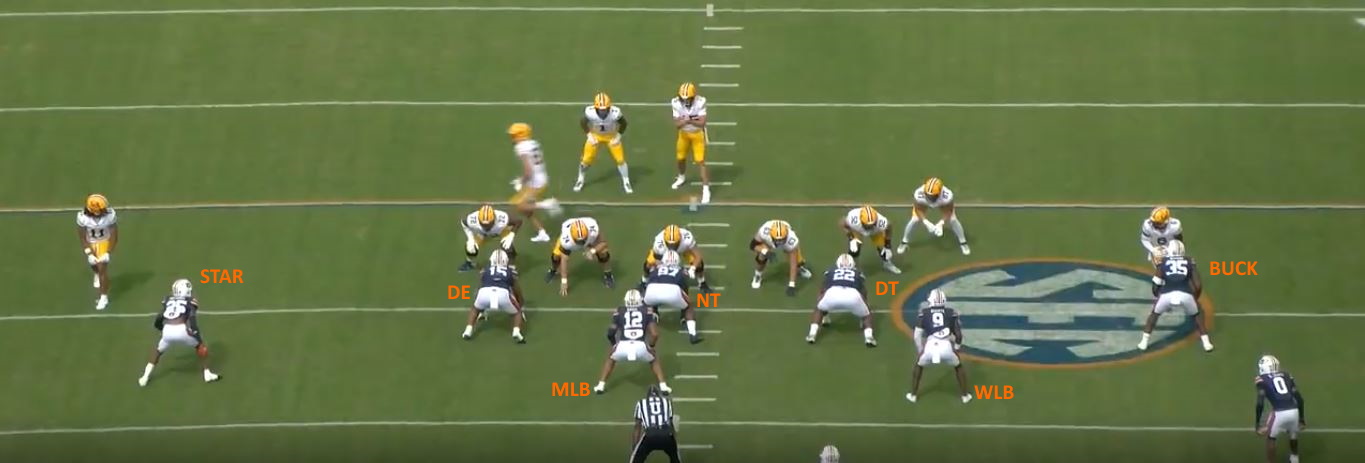
They will also shift players around to utilize the BUCK as a 4-3 defensive end-type player and operate in a 4-3 style defense, with the STAR replacing the SLB.
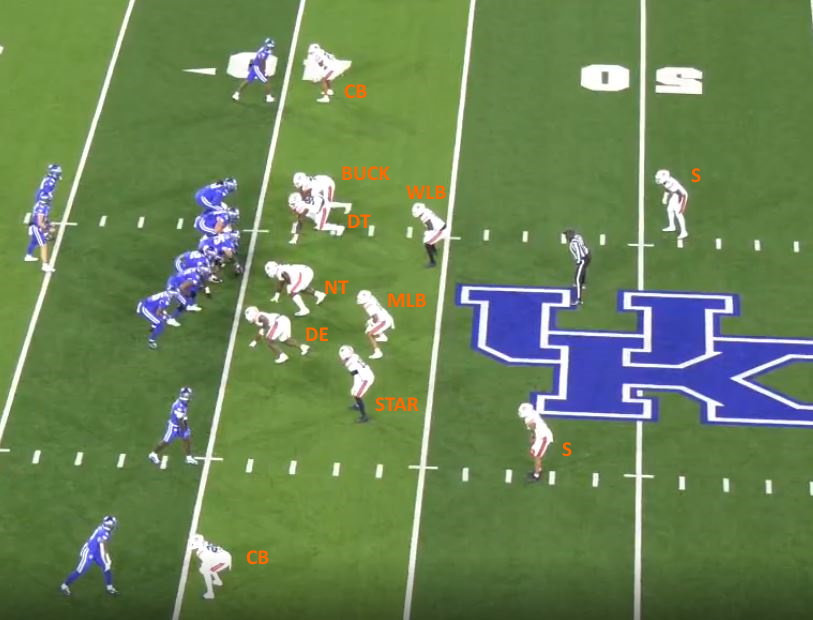
When they face heavier personnel groupings, their personnel may break into a base set similar to this, with both the three-down and four-down alignments, depending on how they use the BUCK.
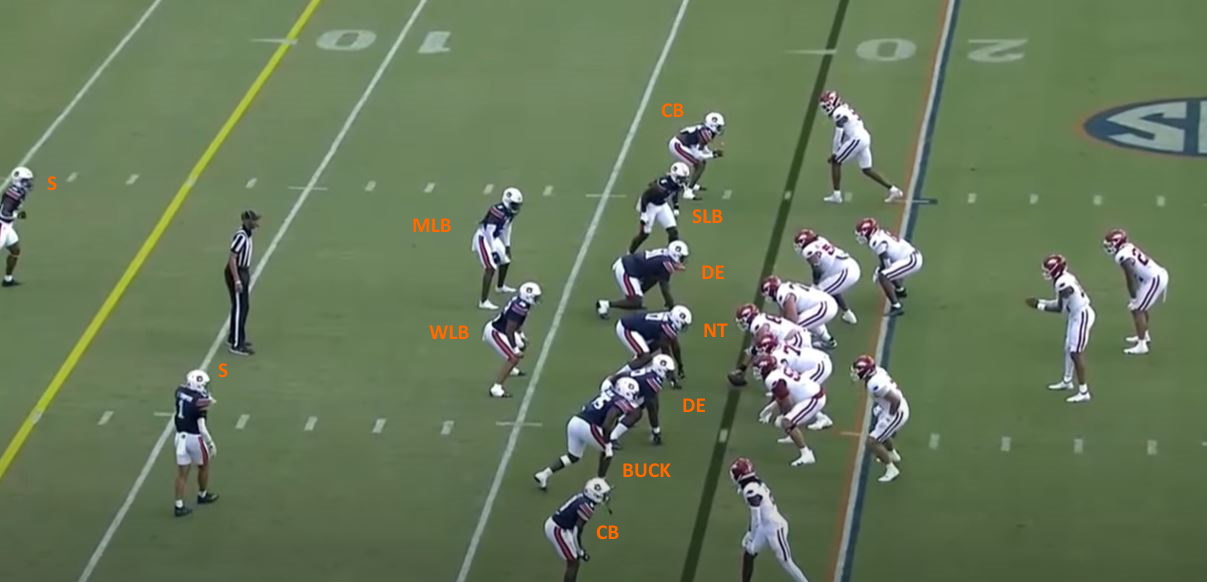
However, the third option is a 3-3-5 similar to how Durkin ran the defense for Kiffin at Ole Miss during the Sugar Bowl. That season, they switched to the ISU style defense when they struggled with the two basic alignment types I broke down above, and it made a huge impact that year.
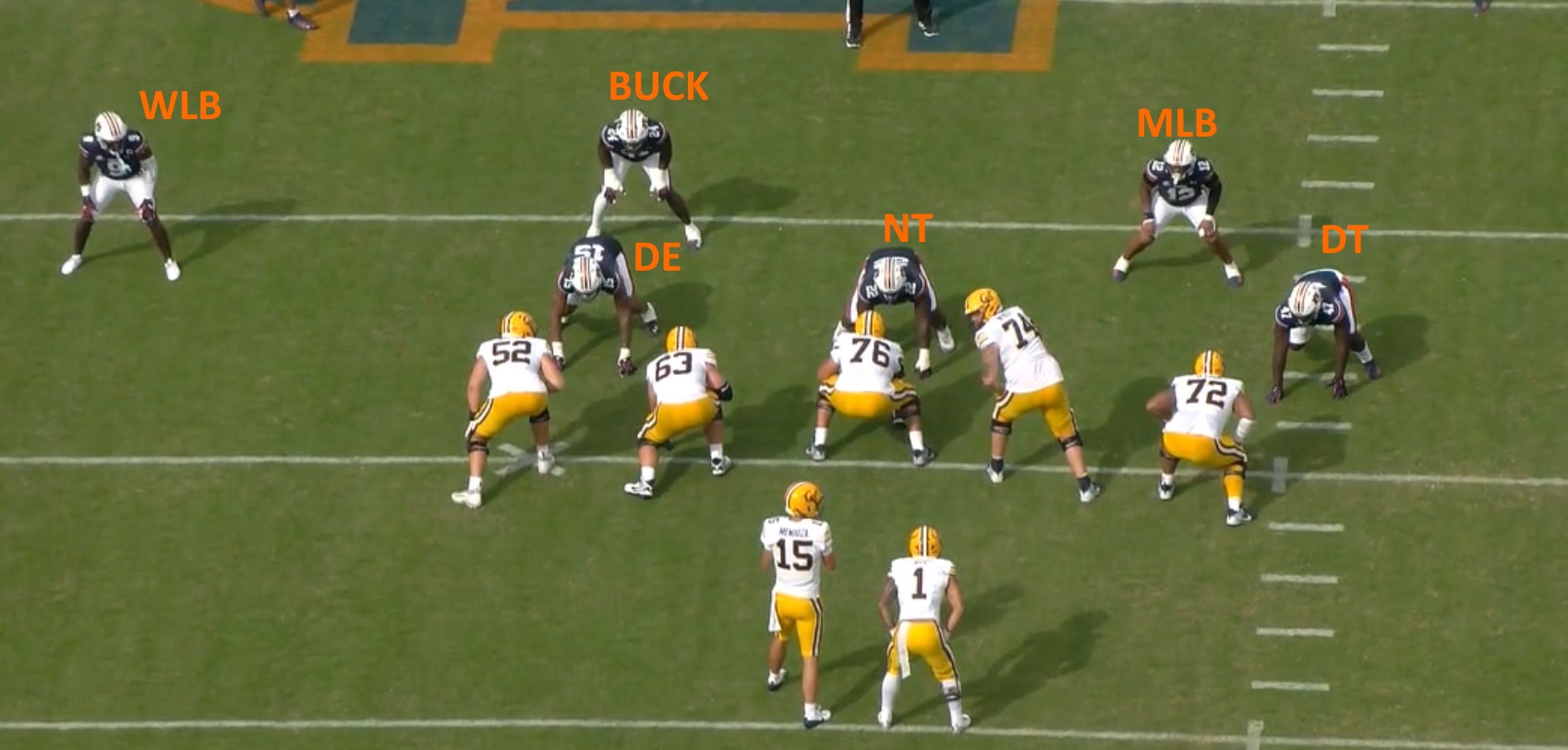
They don’t necessarily substitute to get into this look as they move the BUCK to a stand-up linebacker alignment behind the nose tackle and between the MLB and WLB. This is similar to how Oklahoma State employed a very similar tactic under Knowles from 2017 to 2021, with players like Colin Oliver and Brock Martin.
This alignment changes how the defense fits the run and offers different matchups in pass rush and pressure packages while offering a bit more protection for the BUCK in coverage given he has a linebacker, a safety or STAR, and then a corner on either side of him in coverage assuming one deep safety. Structurally it’s very similar to Iowa State and it’s quite the change up from their normal structure. It gives a ton of ability to change and disguise coverages, as ISU has shown for years.
It’s a defense that, in coverage, likes to base out of Saban’s pattern-matching one-high coverage variations derived from Cover 3, with a fair bit of quarters coverages as well, on base downs, with no fear of bringing pressure and offering single coverage on passing downs, where they can get off the field. This was also a trend when he was running the Ole Miss defense I previewed before the Sugar Bowl; even when that defense lived in safer zone coverages on standard downs, it went after you when gambling could get them off the field.
In terms of run defense, they will stunt and move some, but also ask their linemen to adopt some two-gapping principles. Here, they stuffed Cal by asking their DL to play more than one gap and could play the three-down ISU-style scheme and limit the run while playing safer coverages.
They showed a lot against Cal, who still ran a variation on Jake Spavital’s scheme last fall, as they promoted from within when Baylor hired him away. They had times when they relied on their match coverages and others when they brought pressure and aggressive single coverages. Here, they had success using a zone pressure to blow up the Cal run attempt.
It’s a multiple defense that isn’t afraid to gamble at times and create negative plays.
Final Questions
How did they defend Cal, who, schematically, is the most similar to Baylor?
They mixed up the fronts and used all three types of fronts, but also really mixed up coverages. Cal wasn’t a good offense production-wise a year ago, but they were able to make plays against man coverage that led to scores. Sawyer Robertson is going to have to do the same with Josh Cameron, Michael Trigg, Ashtyn Hawkins, Kole Wilson and others.
They also struggled to run it, but stayed balanced. Durkin brings pressure to disrupt and wants to make you one-dimensional. Don’t let him tee off on the QB and gash them when they get sloppy with their gaps.
How do the injury losses of Devin Turner and Carl Williams impact this game?
It’s huge both as starters and with regard to depth. Carl Williams is a great cover guy at STAR, and a great leader, while Devin Turner would have solidified his spot. Now, Baylor will turn to multiple options at STAR and will likely turn to Tyler Turner, who is a young but athletic option who transferred in from Oregon.
What did you see from Arnold as a QB?
He’s a very dangerous runner and has a big arm. His highlights, however, don’t show much in terms of touch throws and throwing on time. That may come, but it’s very much TBD. If Baylor can pressure him and keep him contained, it becomes a potentially big edge.
Prediction?
Auburn has a lot of talent and will be aggressive in challenging Baylor schematically. I don’t think Baylor is all of a sudden going to be great defensively, but I am simply not sold on Auburn like some other matchups. If we are assuming Baylor’s front is at all capable of limiting the run or getting pressure, it should slow Auburn down unless one of the QBs all of a sudden plays dramatically better than we’ve seen.
Both teams have solid defensive lines and linebackers capable of bringing exotic pressures and also asking their front to two-gap at times. Both have solid skill weapons on offense and wide-open schemes. Both will have QBs capable of making long runs with dangerous mobility. Auburn has a better secondary, but Baylor has the clearly superior QB, given how well he throws and runs.
However, I just have concerns about Baylor’s secondary, given the issues we’ve seen at times with assignment discipline. I don’t feel good picking either team given the unknowns, but I think Baylor would win a close one had they been healthy, and I think Auburn gets let off the hook by a mental bust late.
- Auburn: 28
- Baylor: 27