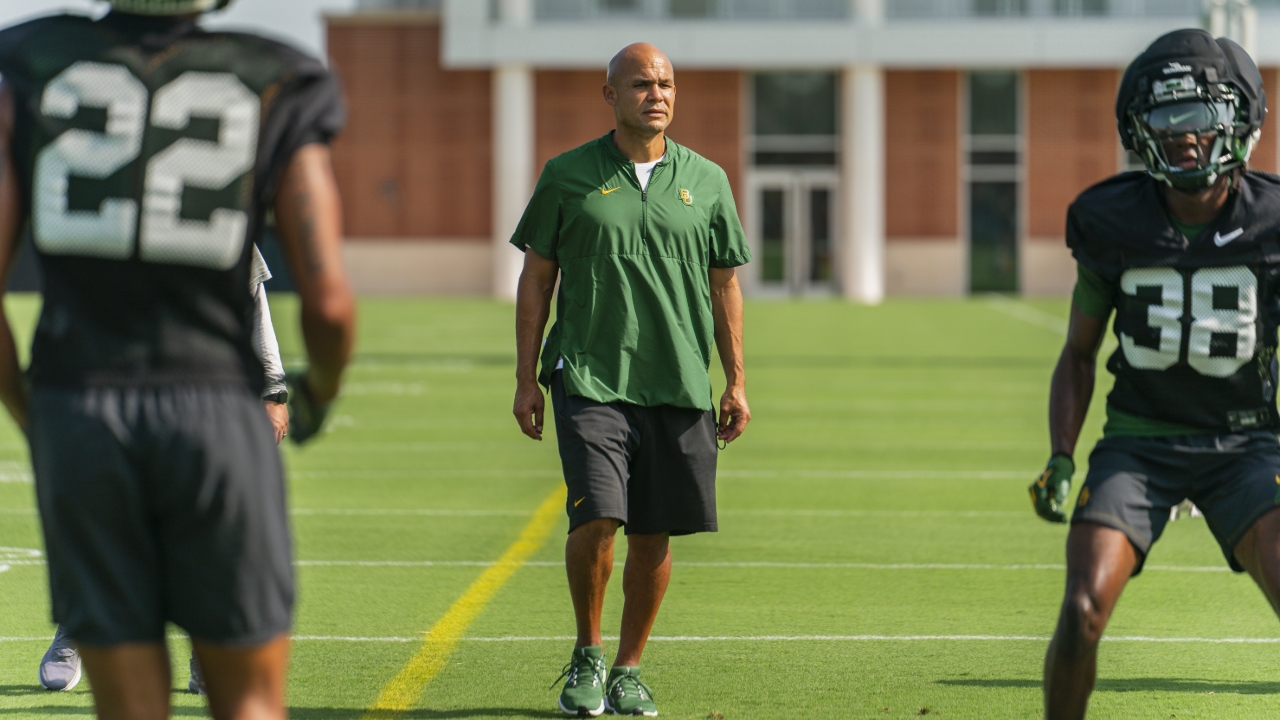
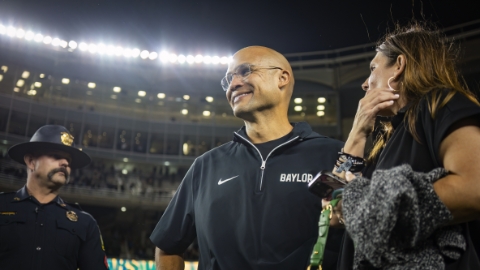
To close Baylor football’s first day of fall camp, head coach Dave Aranda stood in front of the media to take questions with seemingly a little more pep in his step than normal.
When asked about his extra energy toward the end of his press conference, Aranda, who appeared half-serious, half-joking, immediately blurted out, “That’s the coffee. That’s the morning practice.”
The confidence stands out because Aranda, entering perhaps the most important season of his Baylor tenure, rests upon arguably the hottest seat of any Power Four head coach in the country. After the Bears missed a bowl game in 2025 despite preseason expectations of competing near the top of the Big 12, his record has slipped to 36-37 overall and 22-28 over the last four seasons.
So what’s behind Aranda’s apparent change in demeanor? Is it seriously the shift to morning practices for fall camp that has helped establish a more consistent routine? Is it the freedom that comes with handing the defense over to Joe Klanderman and moving back into a CEO-type role? Does he genuinely feel really good about his roster? According to Aranda, the answer is much simpler: he’s “having fun” again.
“I’m having fun, despite whatever things are in the mix,” the seventh-year head coach said. “We’ve got a good group of coaches, a good group of players. Yesterday we had a welcome and introductions meeting in our team room, and it was packed. There were however many people from athletic administration, the equipment room and the ticket office, and they all introduced themselves. There’s such a community at Baylor of people who are just backing you up. I think for the kids, a lot of the talk was, ‘Hey, man, I’m still trying to remember that person’s name, but I didn’t know there were so many people that had our back.’ I think that’s an important message to get across because sometimes you can lose that.”
With this year’s team in particular, Aranda spoke at length about the leadership committee and the players’ commitment to taking ownership of the program by making sure things are done the right way, especially in the classroom, where the Bears posted the best academic semester in program history, as well as in the weight room and on the field.
“They don’t want to let their brothers down, and then they own it,” Aranda said. “They’re like, ‘This is me. This is my team. This is on my watch.’ We’ve had that in the spring and then the summer — great player leadership.”
Aranda continued, “I think we had 60 guys on the team run over 21 miles per hour. Last year, I think we had 18. There are numbers like that where guys are engaged and locked in. I’m excited to see what can become of that. You want to see people who are fighting for each other and people who own it come September.”
Obviously, these are cool notes and nuggets to pass along, but Aranda has said similar things in the past, and it hasn’t necessarily translated to wins on the field. A common theme that’s been an issue in Aranda’s tenure has been his team’s inability to start games fast, something that’s being heavily emphasized throughout this year’s fall camp.
“That’s a mindset, and there’s not a grace period where you’re transitioning into this,” Aranda said of playing and starting fast throughout practice. “If you’re buckled up, if you’re strapping it up tight, it’s not pillowed out. Get your mouthpiece in. All of that’s a thing, because I think everyone will strap up tight and put their mouthpiece in when it’s time to go [in the game]. When you start [practice fast], it’s time to go. There is no warm-up period, like we’re hitting it. I thought the guys were able to do that today.”
While Aranda struck an optimistic tone for most of the afternoon, one major cloud still hangs over Baylor’s preseason: the unresolved eligibility case of defensive lineman Hosea Wheeler.
“It’s difficult because you can’t really assert yourself,” Aranda said of the recent eligibility battles. “You can’t be in the middle to stay updated. Truthfully, there’s not a lot of input coming to me, and it’s not really a place where I can go and ask about it either.”
Wheeler, the Indiana transfer, posted 31 tackles, four for loss, 11 quarterback pressures and two fumble recoveries last season for the National Champion Hoosiers. Originally, Wheeler was a member of the Pavia v. NCAA lawsuit, seeking an extra year of Division I eligibility after spending the 2021 season at Sacramento City College, a junior college.
After waiting months for an NCAA ruling, Wheeler eventually dropped the case and is now seeking a temporary injunction in McLennan County from Judge Ryan Luna, the same judge who denied offensive lineman Yakiri Walker’s eligibility request. The impending hearing, which is set for Aug. 11, has put Baylor’s defense in limbo, as Wheeler is expected to be one of Baylor’s best defenders.
“We very much want Hosea on this team and contributing, so it’s just a weird space,” Aranda said. “The thing about it is, it’s weird for him to lead and to bring the energy and do all of it, not knowing if this is the last day or whatever else. Right now, this is where we’re at, and I credit both Yak and Hosea and their families for going at it in a classy way because we’re right up to starting everything off, and to get stuff that’s really late like this is a big mental lift.”
The aforementioned Walker, the Memphis transfer, was unable to get an extra season of eligibility after playing just three snaps at Colorado in 2024. Walker was slated to be Baylor’s starting center, and with that now out of the picture, he’s joined the Bears’ coaching staff as an analyst for the 2026 season.
Aranda explained Walker’s situation, saying, “If it didn’t work out, what was our plan? Because at that point, the supplemental draft had come and gone, and he brought up coaching, saying that he wanted to coach. So that was something that we agreed to and wanted to do if we didn’t get the verdict that we wanted.”
When asked about how Baylor’s offensive line will make up for the loss of Walker, Aranda mentioned his belief in the left and right tackles, Logan Moore and Kaden Sieracki, noting that Moore, the UAB transfer, was a “big get for us at the beginning of the portal” and that Sieracki is “the most improved player on the team.” Aranda did, however, express some concern about the interior of the offensive line, saying, “We’ve got to get the inside stronger.”
“The outside guys are really talented, and there has not really been any disruption with them,” Aranda added. “There’s been some moving pieces on the inside. We’ve got to get that settled down. That showed up a little bit, too, but that was kind of expected. We’ve got a lot of days to get that to where it’s settled down. We’ve got Cole Rhett, who’s a guy that could be outside and inside. We’ve just got to be able to get where we’re running double teams and working up to linebackers, so that we’re moving people in the process of doing that.”
Behind that offensive line is Florida transfer quarterback DJ Lagway leading the charge at his father’s alma mater. Lagway made some headlines at Big 12 Media Days, discussing how this was his first healthy offseason of his collegiate career and how at Baylor, he’s been able to play a lot more freely and doesn’t feel the same sense of pressure that he did in Gainesville.
“There’s more confidence with him,” Aranda said of Lagway. “Just within drills, there’s really free discourse with receivers and running backs, and even with Coach Spav, there’s back and forth. There’s a freedom that you feel with him, an ability to play a little bit looser than he was. We want to be able to get that type of DJ Lagway that plays free and lets it rip on Saturdays.”
On a closing note, Aranda discussed changes made in the offseason by Vic Viloria, the head strength and conditioning coach, to prevent injuries and improve Baylor’s overall performance on the field.
“We did a lot more running and agility than we ever did, so speed work and agility work,” Aranda said of the updates to the strength and conditioning program. “In the past, it’s been really kind of heavy lifting work, so a lot more change-of-direction, running, skill-related work, starts and stops, change of direction. There’s that, and then I think the lifts. There was less weight for weight’s sake and more explosive movements for reps. So lighter weight, more reps, and we did that to try to keep as many people healthy, especially their backs healthy, and to get people from the start to the finish line, and then also create explosiveness.”