Saved for a Purpose: Dallas Baker’s Journey from Darkness Back to the Sidelines
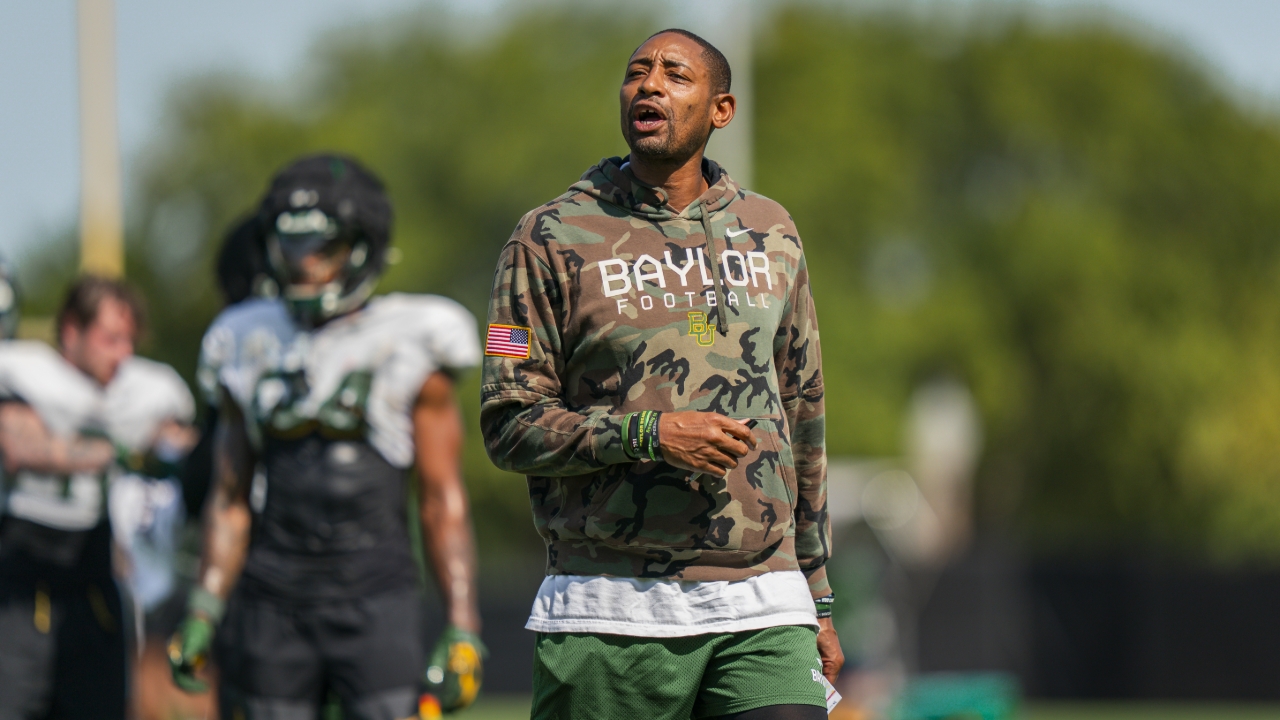
Everyone has heard stories about incredibly talented athletes who threw their lives away for nothing. The whole world was at their fingertips, and they blew it. For years, Dallas Baker looked like another cautionary tale about extraordinary talent overtaken by poor decisions. Today, however, his story is defined less by his mistakes and more by his faith and what he believes God called him to do afterward.
Ever since he was a young boy, Baker dreamed of playing at the University of Florida and eventually going pro. Baker would gladly sport his Uncle Wes's jersey on career day throughout elementary school and tell the class he was “going to play in the NFL” during the week; on weekends, he would play Pop Warner and look like a man among boys.
His uncle, Wes Chandler, was a two-time All-American at UF, the No. 3 overall pick in the 1978 NFL Draft, and a four-time Pro Bowler over his decade-plus career with the Saints and Chargers. It was in Baker’s blood. He was born to reach the next level and never doubted himself.
That confidence paid off as Baker dominated at New Smyrna Beach High School, where he was named Central Florida’s Player of the Year in 2000 after catching 68 passes for 1,140 yards with 16 touchdowns. He signed with Florida, his dream school, in February 2001, but because he needed better grades, he spent the fall at a prep school in Massachusetts.
One afternoon, an associate dean of the Northfield Mt. Hermon School spoke in front of all the 12th graders and postgraduates and boldly stated, “I want everyone in here to take their education seriously because no one’s going to be a professional athlete or play big-time college sports.”
Baker looked around the classroom for a few seconds, then his hand shot up, and the dean let him speak. “I don’t know about anybody else in here, but you’re wrong,” Baker retorted.
The two sparred back and forth for a few more minutes before Baker had enough and said, “Listen, man. I’m Dallas Baker, the touchdown-maker. I played at the University of Florida before I got kicked out. I’m going back there and then going to the NFL.”
Well, as arrogant as he may have come across, he was right. Baker got his grades in order and returned to Gainesville ahead of the 2002 season, when he redshirted.
After a promising start to his collegiate career in 2003, when he hauled in 13 receptions for 209 yards and a touchdown, Baker’s life flipped on a dime on Sept. 18, 2004, when the No. 11 Gators traveled to face No. 13 Tennessee in front of nearly 110,000 people at Neyland Stadium.
Florida had all but wrapped up a road upset over its rival and ran a half-back dive into the teeth of the Tennessee defense on a third down that should have drained most of the remaining clock. Away from the play, however, Baker retaliated after Tennessee cornerback Jonathan Wade struck him, and the officials penalized Baker 15 yards for unsportsmanlike conduct. Of course, the officials always catch the second person.
The penalty pushed Florida backward before its punt, and the clock controversially remained stopped at 55 seconds. Tennessee used the additional time and favorable field position to drive for James Wilhoit’s game-winning 50-yard field goal, handing the Gators a stunning 30-28 loss.
Baker said he received so many death threats upon returning to Gainesville that the pressure became overwhelming. In fact, his teammate Channing Crowder nudged Baker awake on the bus ride back from the airport to see “THANKS BAKER” spray-painted on a wall on SW 34th Street.
Consumed by guilt and the feeling that he had failed everyone around him, he attempted suicide. Baker finished the season, and when Florida hired Urban Meyer and wide receivers coach Billy Gonzales that winter, he found two mentors whom he now credits with helping save his life.
By the time he was an upperclassman, Baker was still struggling with depression and couldn’t find joy at times in playing football. Still, he had solidified himself as a star: he was Florida’s leading wide receiver on the national championship-winning 2006 team. He earned First-Team All-SEC honors with 920 receiving yards, 60 receptions and 10 touchdowns.
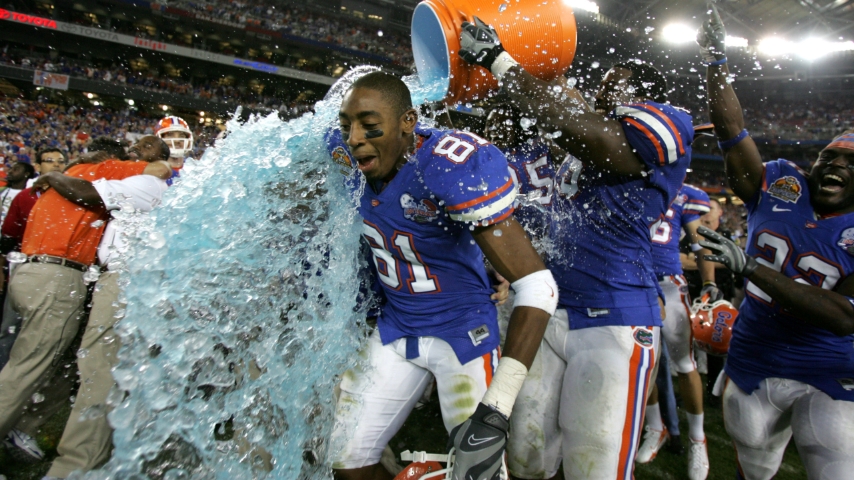
Following Baker’s collegiate career, which included a laundry list of accolades, he had the perfect build, standing at 6-foot-3, 210 pounds, to be an early-round talent in the NFL Draft. The problem, however, was that Baker didn’t take his preparation seriously. He barely bothered to train, only doing so a handful of times ahead of the NFL Combine.
“Everything else, I was in the top five, but everyone wanted to know how fast I was, and I didn’t run fast because I didn’t train,” Baker said. “I was too busy spending the money I was making from endorsement deals, buying cars and things like that. I had just won the National Championship, and I was one of the top receivers in the country. Instead of focusing on what was ahead, I was too busy enjoying that moment there.”
That lack of focus hurt Baker, as he dropped down draft boards and fell to the seventh round, where the Pittsburgh Steelers selected him with the No. 227 overall pick. Instead of using the slip in his draft stock as motivation, or acknowledging the fact that he was one of 255 players in the country to get selected, he wanted to give up on football.
“I fell four rounds in the NFL Draft, and from that moment I hated football because I felt like I let myself and everyone down,” Baker said. “It only got worse because my care factor made me play less than I was capable of. If it wasn’t for me thinking, 'If I kill myself, I’m going to hell,’ I would’ve gone through with it because I did try.”
Baker added, “There are guys who would love to be drafted, but I sat in my mom’s room and pouted. When I got there, I tried to quit all the time. Here it is, a seventh-round draft pick, and you keep telling them you want to retire, and they won’t let you. That’s a sign right there that should have told me that I was pretty good, but I was so ungrateful. The sad part is, I have a younger brother who played at Fairmont State, 45 minutes from Pittsburgh, and I still didn’t see the blessing.”
Despite having all the talent in the world, Baker’s attitude kept him from sticking in the NFL, as he spent the 2007 season on the Steelers’ practice squad, made the 53-man roster in 2008 and played in eight games, recording one catch for six yards on the Super Bowl-winning team, and then was finally released ahead of the 2009 season.
From there, Baker’s NFL time came to a close, and he globe-trotted across North America, bouncing around the Arena and Canadian Football Leagues, playing in Jacksonville, Montreal, Saskatchewan and San Antonio. By 2014, Baker had hung up his cleats, and after losing his grandmother, he began to drift into darker waters.
Baker ultimately decided to do what unfortunately a lot of people from his hometown of New Smyrna Beach would do if they were unable to find a way out: get involved with a gang and sell drugs. The only thing is, Baker wanted to be bigger and better and desired to be a kingpin whose range extended from Jacksonville to north of Miami.
He started by pawning his rings from the BCS National Championship and the SEC Championship, and he put his Super Bowl ring up as collateral. Pretty quickly, the money started flowing in, and Baker was selling almost anything you can think of.
Baker, however, broke the cardinal rule of drug dealing: he started to get high on his own supply, although he emphatically states, “I never stuck anything in my nose or in my veins. I hate needles.” As his drug use became more frequent, a deal involving one of his partners ended in a shootout, costing Baker a significant amount of money and drugs.
Now depressed that what he was building had come crashing down, in a sense, Baker was a disheveled mess and suffered a minor heart attack after going on a bender partying by the beach. Baker ignored the warning signs and, less than a week after leaving the hospital, was back on another bender, and his life flashed before his eyes when he got in a car wreck that flipped his vehicle.
Once Baker realized he was still alive, the cops, who had arrived on the scene, allowed him to leave without doing a breathalyzer test or searching his car. The vehicle, although damaged, could be driven just fine. Once Baker was back on the road, he sat in silence as tears streamed down his face before popping a gospel CD into the stereo.
“I lost my mind,” Baker said. “I was up for three days. My parents know now. People in the community know. I thought I was hiding. I was 195 pounds, and I’m embarrassed. I started crying and asked the Good Lord to please take my life and to please save me. I didn’t want to do it anymore.”
Although he didn’t want to admit it, Baker knew where his comfort zone was, so he returned home to New Smyrna Beach, moved back in with his parents, and started attending church regularly again.
One day, Baker was lifting weights in the New Smyrna Beach High School gym when the baseball coach, David Moskovits, walked in and asked, “Dallas, what are you doing back in town?”
“Oh, well.... I’m just visiting my parents,” Baker said, trying to save face.
Moskovits responded, “What are you doing with yourself now?”
“Nothing, but I’d like to be a college football coach someday,” Baker responded.
“It’s interesting you say that,” Moskovits responded. “Because there’s an NAIA school called Warner University, where my son works. He’s the assistant baseball coach. You know David. Why don’t you give him a call?”
Baker lit up with excitement and called David, but the only issue was that Baker needed a resume — he’d never had one, much less ever thought about creating one. Once he got settled, he shared it with Warner’s head football coach. The next step was an interview, another thing that Baker had never done before, and he came in completely unprepared.
“He just hired me because Polk County is Gator Country,” Baker said, laughing. “I had never coached receivers in my life. I had no idea what I was doing. All I was doing was what Coach Billy Gonzales taught us at Florida. I was so unorganized at first.”
The coaching life, however, didn’t prove very luxurious for Baker: he made $15,000 a year and lived in a house provided by the university, but he couldn’t afford the electric or water bill. To make matters worse, in his first season as the wide receivers coach, the team went 2-9.
“When I say there was nothing in there except for the furniture, I mean it,” Baker said. “No cable, no electricity. I would stay at Warner, and I’d play video games with the guys all day. So that way, when 10 o'clock hit, I would finally go home and sleep. Then I’d wake up at five before everybody else to get there. I'm gonna take a shower in the coach's locker room and pretend like I've been there the entire time watching film, but no, I'm using that place to brush my teeth, take a shower and use the cafeteria to eat.”
On the field, things started to turn around in Baker’s second season: the Royals went 9-2, but he could still barely get by, much less provide for his wife and daughter, who weren’t staying with him at the time. When his wife would visit and see how Baker was living, she told him that he needed to figure something out and fast. In a last-ditch effort, she gave Baker some cash to visit Urban Meyer, who had taken the head coaching job at Ohio State.
After spending some time in Ohio, Baker returned home to Florida. He spent the next week praying and fasting, asking God if coaching was where he was supposed to be and whether a door would open.
Soon after spring practices began, as he headed into his third year at Warner University, Baker realized he'd left his script in the locker room. When he ran back inside, he saw his phone ringing, and when he went to turn the ringer off, he realized it was Meyer calling him.
Baker picked up the phone and, in a hurry, said, “Hey, Coach. Can I call you later? We’re about to go to practice.”
Meyer chuckled and said, “No, you’re not.”
Baker, confused, hesitated and responded, “What are you talking about?”
“Doc just called me,” Meyer told Baker, referencing Doc Holliday, the then-Marshall head coach and associate head coach at Florida from 2005-07. “He just lost his receivers coach and wanted to know if I knew a minority coach, and I told him Dallas Baker.”
Baker, full of excitement, landed the job at Marshall and started to find his footing, despite never being a graduate assistant or quality control coach. He helped Marshall receivers Tyre Brady and Marcel Williams earn All-Conference USA honors in back-to-back seasons. Brady compiled 1,000-plus receiving yards in back-to-back seasons, joining the ranks of Marshall’s most famous alum, Pro Football Hall of Famer Randy Moss.
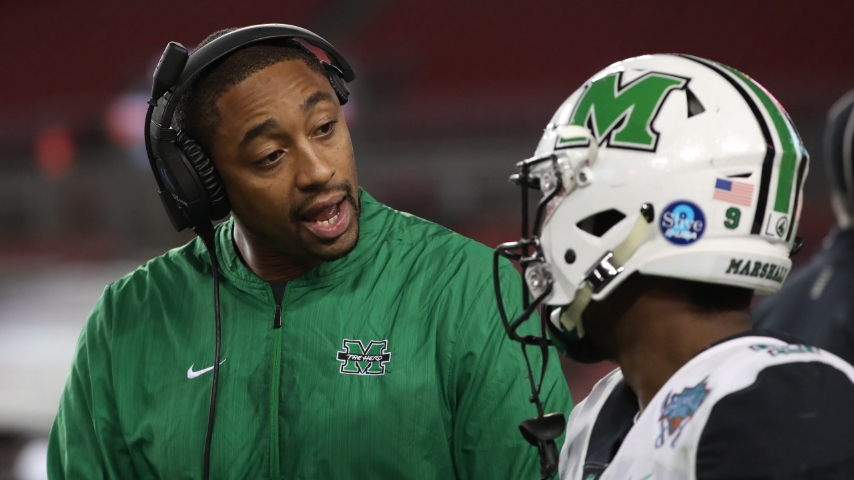
Despite compiling a 31-17 record and four bowl appearances from 2017 to 2020, Holliday and the rest of the Marshall staff were laid off at the conclusion of the 2020 season. Baker had an opportunity to go back home to Gainesville and get a job on Dan Mullen’s recruiting staff, but Baker wasn’t one to jump for more money, and something told him to wait.
“I tell my guys all the time: don't live as Batman did in the movie when he went against Bane,” Baker said. “He couldn't make the jump because he had the rope around him, right? That rope was his security blanket. That rope also held him back from jumping as far as he could, and then he took it off. He knew, like, I gotta make this jump, or I’m going to die.”
Baker fasted again, and he prayed. He noticed Buffalo needed a wide receivers coach, incredibly late in the cycle, because Lance Leipold left for Kansas in late April and Maurice Linguist took the job in early May.
While all this was happening, Baker decided one Friday afternoon that he’d take his wife and daughter, Angelina, to a theme park in Orlando: Universal’s Islands of Adventure.
As they were getting ready for bed, Baker told his wife, “Hey, the reason I want to go to Orlando is because I’m about to leave soon.”
Vanessa quipped back, “You got a job and didn’t tell me?”
“Yeah,” Baker said. “I’m about to be the receivers coach at the University of Buffalo.”
She responded, “When did this happen?”
“Well, I haven’t talked to anyone yet, but I know God’s going to open that door for me,” Baker stated.
“Yeah. Whatever, Dallas,” Vanessa said and rolled over to go to sleep.
Vanessa had spent the last decade-plus mad at God. In 2008, when Baker and the Steelers were facing the Browns, she went into labor. Without Baker by her side, she bled out so much that she nearly died. The doctors had to take emergency precautions to get their daughter out alive; she came out not breathing, hence why her name is Angelina because she’s the couple’s angel. The doctors revived Vanessa and gave her a hysterectomy, and because of that experience, she understandably harbored a lot of resentment.
So when the Bakers woke up on Saturday to head to Orlando, he told his wife again, “God is making me feel like I’m about to be the receivers coach at the University of Buffalo.”
“Whatever you say, babe,” Vanessa responded.
Baker called Billy Gonzales, his wide receivers coach in college at Florida, and asked if he knew Linguist, Buffalo’s head coach. In fact, Gonzales did, since they'd both been at Mississippi State. After a few more phone calls, Baker heard from Shane Montgomery, Buffalo’s offensive coordinator at the time and a former Miami (Ohio) head coach. Then Ben Roethlisberger, Baker’s former Steelers teammate and a future Hall of Fame quarterback, called to ask him a few questions.
Baker looked at his wife and said, “That was the University of Buffalo,” and her eyes went wide as she sat in the car in disbelief.
As they lined up to get into the theme park, Baker got another call, this time from Linguist, the head coach at Buffalo, who told him he’d fly him up to New York for an interview in the coming days.
Not long after, Linguist called back and said, “Dallas, I don’t know what it is, but I don’t even want you to interview. I’m going to send you a contract over right now.”
Baker got off the phone and told his wife, who was standing next to him, and she started crying and muttered, “I believe in God again.”
“Here's how God used me to go through my trials and tribulations to get my wife back praying with me at night here, reading the Bible with me,” Baker said.
In his lone season at Buffalo, Baker was surrounded by people who had connections to Baylor. Linguist, the Bulls head coach, played in Waco from 2006-07. Andy McCollum, a veteran coach and defensive analyst at Buffalo, spent five seasons as Baylor’s linebacker coach (1994-98).
“Mo and Coach McCollum talk about Texas football all the time,” Baker said. “Coach McCollum coached a young guy by the name of Rodney Smith, who played football and basketball. I’m like, ‘Who the freak is Rodney Smith?’ It turns out, you know who Rodney Smith’s son is? London Smith.”
Linguist had another curious Baylor connection and mutual friend with Baker: punter Daniel Sepulveda, the two-time Ray Guy Award winner and 2006 All-American, who spent five seasons in the NFL in Pittsburgh.
“Mo’s really good friends with the guy who I’m really good friends with, who I talked to last month when we inducted him into the Hall of Fame,” Baker noted. “You ever heard of a guy named Daniel Sepulveda who got drafted by the Steelers in the 2007 NFL Draft? We lived right next door, and we’d play Guitar Hero every single day with each other.”
With all these seemingly random ties to Baylor, Baker watched the Bears often during the 2021 season, their program-record 12-win campaign, which featured a Big 12 Championship and Sugar Bowl victory.
“I’m an SEC guy, so I’m like, ‘Ole Miss is gonna beat Baylor,’” Baker said. “I watched a little guy named Monaray Baldwin score that touchdown, and I thought it’d be cool for me to coach somebody like that one day. That ended up being one of my wife’s favorite players that I coached.”
A few weeks later, Baker’s friend and Baylor’s wide receivers coach Chansi Stuckey left for Notre Dame, opening up a potential spot in Waco. Baker was walking through the Tampa Bay airport when he saw a number from Hawaii and didn’t answer because he thought it was a bill collector.
“Hi, it’s Dave Aranda. I’m looking for Dallas Baker.”
He immediately called him back.
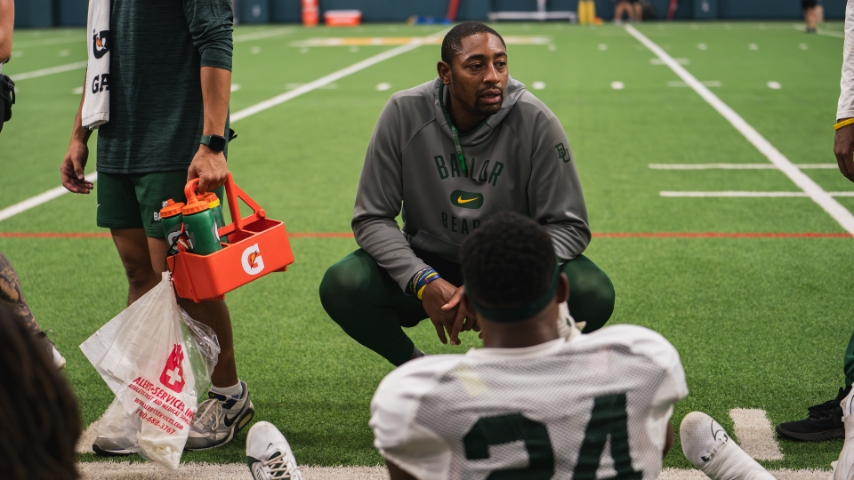
“A lot of the receivers that were here were going to transfer,” Baker said. “So Coach Aranda was looking not necessarily for someone who knew a ton about football, but for someone who could be a person-over-player coach. That's exactly what he wanted. I give God the glory because that's who I try to be. I coach them hard, but I try to be that.”
The interview didn’t go according to plan: Baker had little to no knowledge of the wide-zone offense and had never made the jump to coaching at the power-conference level, but he trusted God was calling him to Waco.
"Coach Aranda, you don't know this, but God already told me this job is mine,” Baker told him. Aranda sat there and just smiled.
A few days later, Baker got the job. Five seasons later, Baker is Baylor’s longest-tenured assistant coach and has turned down jobs to return to his home state and be the wide receivers coach at Florida and Miami because he feels like he isn’t finished at Baylor.
“Every job I've gotten, people think it's been because of my connections,” Baker said. “I have an agent now, but that was just last year. I never had an agent. It wasn't because of my connections. God used other people to open the door, but it's been because I have done the work of God, so that's why I glorify him. Why would I not glorify God?”
Baker’s not in the business of making more money or getting a flashy new title, as he has no ambition to be a head coach or offensive coordinator. He wants to make an impact on the wide receivers in his room and help prevent them from making the same mistakes he did. Plus, Baker wants to instill a positive mindset in his unit and remind them that “if the good Lord allows you to put your feet on the ground, you’re blessed.”
“He’s had a really good impact on me,” current Baylor fifth-year senior wide receiver Gavin Freeman said. “He's probably one of the most hands-on coaches I've played for. He keeps my head on straight. He keeps all the receivers' heads on straight. He was the first person to call me out of the portal, and he believes in me, and that means a lot to me.”
Junior Jadon Porter added, “When I first got here freshman year, I was decent. I was a regular player. Then when I really took Coach Bake’s coaching, it took me to the next level. Everything he was saying was true, but I didn’t want to see it as true. When I got home and went over what he was saying, he was right. He always has good stuff to say. Football is what we do, but it’s not who we are. He’s pushed me to be a greater man, greater football player, greater man of God, greater everything.”
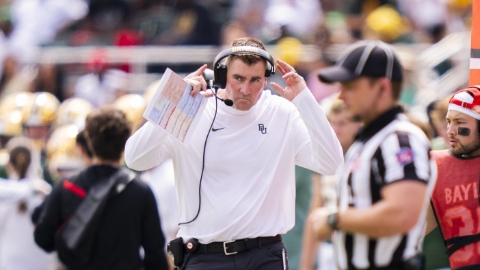
Nowadays, Dallas Baker, the “Touchdown Maker,” has become Dallas Baker, the “Difference Maker.” Every morning, he sends Scripture to his wide receivers. During practice, he holds his players accountable but is quick to put an arm around them and remind them how much he cares. On game days, he’s right in the middle of the action — fired up over a receiver’s key block or celebrating a touchdown alongside his unit.
If you notice Baker jumping for joy on Saturdays, know he's right where God called him to be, saying, “That doesn’t come from anybody that walked the face of the earth — it comes from God.”
Baker later continued, “I’m praising the Lord. I don’t care if people think I’m crazy. I don’t care if people think I’m drunk. I don’t care if people think I’m trying to be cool. I’m not doing it for them. That impacts the players because it’s like, ‘Look at Coach Bake. I need to have that type of energy.’ But it also allows me to tell them about God because they’re like, ‘Coach Bake, you still think you’re young?’ They’re lying because when I’m done with practice, my knees feel like I’ve just played in six games back-to-back. Here’s why I’m jumping up and down, and then they’re asking more questions about God.”