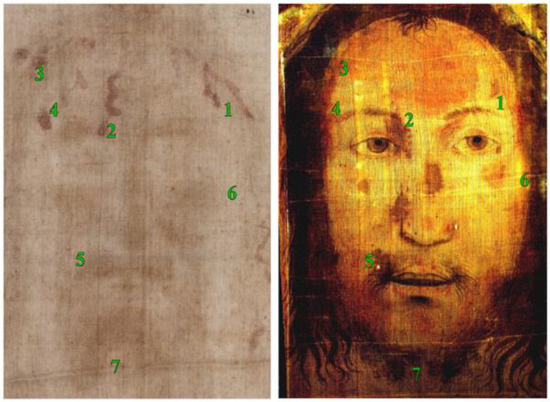
With regards to these two artifacts, I go back to the description of John's Gospel of that first Pascha morning.
3 Peter therefore went out, and the other disciple, and were going to the tomb. 4 So they both ran together, and the other disciple outran Peter and came to the tomb first. 5 And he, stooping down and looking in, saw the linen cloths lying there; yet he did not go in. 6 Then Simon Peter came, following him, and went into the tomb; and he saw the linen cloths lying there, 7 and the [a]handkerchief that had been around His head, not lying with the linen cloths, but folded together in a place by itself. 8 Then the other disciple, who came to the tomb first, went in also; and he saw and believed.1. Two disciples ran to the tomb.
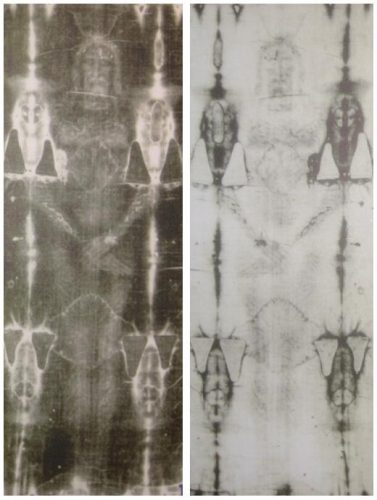
2. The other disciple got there first, looked in from the outside, but didn't go in. This allowed him to verify the fact that the stone had been rolled away, the tomb did not contain a body, and the gravecloth (probably the shroud) laying there. Probably couldn't make out what was on it from outside. But the full image on the shroud isn't 100% clear unless viewed as a photographic negative.
3. Peter gets there, goes in, and sees the gravecloth and the facecloth not lying with the gravecloth but folded and neatly set aside. He verifies the images, particularly the one on the facecloth that is 100% clear.
4. The other disciple then goes in, sees both, and believes.
5. I would also add that the idea of "an image made without hands" goes back in time to the very beginnings of our faith. Eusebius records that this was taken from Jerusalem to Edessa by Thaddeus (one of the 70), with later historians recording that it was taken from Edessa to Constantinople. Here it was known as the Mandylion, and carried by Byzantine armies like the Ark of the Covenant. In fact, modern Russian military units often fly a flag derived from the Mandylion.

Then there is a gap. Its presence in Rome is first recorded 1207 with its first procession. My strong suspicion is that this is one of the artifacts looted from Constantinople during the fourth crusade (1202-1204). It was "lost" during the sack of Rome in 1527 (this is when I think it was taken to Manopello). In 1629, Pope
Urban VIII not only prohibited reproductions of the Veronica from being made, but also ordered the destruction of all existing copies. His edict declared that anyone who had access to a copy must bring it to the Vatican, under penalty of excommunication. So while broad knowledge of the true image was not lost in the Orthodox world, it was lost in the west.
The gravecloth:
The facecloth:

Comparing the gravecloth to the facecloth: