Wangchung said:
1713 Baylor said:
Wangchung said:
1713 Baylor said:
Wangchung said:
1713 Baylor said:
I've watched all four films. Took two hours to back them up, re-run them, stop in place, repeat as necessary to make sure I understood exactly what was happening. This was murder, plain and simple, and entirely avoidable.
90% of the people on this forum, haven't watched the videos, maybe more, or they wouldn't be saying the assinine **** they're saying.
This is a Warren-T Rat moment: "who you gonna believe, me or your own eyes?' You guys are choosing to believe the bull**** and refusing to open your own eyes.
That's a straight lie that's easily refuted by video. SHE HIT THE ICE AGENT BEFORE SHE WAS SHOT. You're simply lying.
Full bull***** Complete utter fabrication, a Lie's lie that can only be wrought from accepting the bull**** propagated by interested parties. In the fourth video (street view opposite), she is about to leave before the ICE agents ever arrive, but a car comes in front of her and she waives it past. Then more ICE agents arrive and approach.
In all three back view videos, when the first two ICE agents approach she puts the car in reverse to back away from them and re-angle the car toward the open street.
In all three of the behind view videos her front tires are turned away from Agents 1 and 2 and toward the street. It is agent 3, the shooter, who interposes himself in front of her car, then as she is beginning to leave, shoots her. She does not 'rev' the car, or aim it at him, she starts slowly and aims it away. By the time he shoots, Agent 3 (shooter) is nearly out of the way, and could have been out of the way and out of harm from the first second he became involved.
Not one of the agents is hurt. Not even in the slightest. "Will recover" what crap. They have nothing to recover from. All four are fully ambulatory. No 3 (shooter) continues to chase her. No one grabs a limb in pain or does anything else to illustrate even the possibility of an injury.
In fact, they're stunned that Agent 3 pulled the trigger. Agent 1 (rear behind the guy at the door) jumps at the shot it is so unexpected, and agent 4 stumbles and falls in surprise from it. Neither were expecting it, because no one would be under these circumstances.
The car proceeds down the road where it is aimed--away from all ICE officers.
In all four films there are no injured agents. None have fallen. None limp or show common reactions to the pain of an injury. All four are fully ambulatory.
WATCH THE ****ING VIDEOS BEFORE YOU CALL SOMEONE A LIAR PIECE OF *****
Liar. Again, the video shows she HIT THE AGENT! You don't get to hit an officer of the law if it only hurts them a little bit, you idiot. She hit the agent with the car! It's on video! You idiot leftists have ZERO integrity.
Side view, she did not.
https://www.washingtonpost.com/wp-apps/imrs.php?src= &w=1440&impolicy=high_res
Sorry, the video I provided shows, in slow motion and highlighted, the officer who was hit by her vehicle, so your still shots are absolutely unconvincing to anyone who can see.
I'm going to quit screaming back at you and trading insults and see if we can reason. If not, then not, but let's give it a go.
The still shots vs. the video. I agree that moving video will always provide useful information. I used in a bunch in my original post, and drew conclusions from them. But the side view still shots are an important piece because they highlight the most key part of the event--the shooting itself. They show each instant in which the officer was shooting (timing confirmed by the gunsmoke coming out of the barrel of the gun). So it is worthwhile to look at them in detail.
In his first shot, he is already to the side of the vehicle and if you look at his feet, her wheels are clearly pointed away from him, not at him. The wheels are pointed in the opposite direction when she backs up and changes her angle to leave.
The ballistic evidence tends to confirm this for shot 1, and when the rest of it becomes available it will also be important. The photograph taken of the vehicle immediately after the incident shows only one bullet hole in the windshield. It is low, and to the far right of the driver judged from the front of the car.
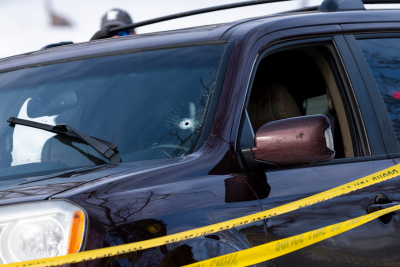
Shot No. 1 would probably not even hit her if made from the middle of the front hood, the angle is all wrong. It would instead pass out the driver's side window or perhaps embed in some part of the frame. It would hit her through the window shield only if the gun was held off the left front fender--physics being what they are and bullets traveling in straight lines unless deflected. I
Bullets 2 and 3 were shot through the window, and the officer is clearly on the side of the vehicle and at least a step or two away from it when he fires both. There doesn't appear to be any argument in his favor for shots 2 and 3, that he feared for his life when the car is separated from him and moving away from him.
Your "she contacted him, so all bets are off" approach isn't the standard by which his conduct will be judged.
You are applying a "moment of impact" sort of analysis--i.e. if the car hit him, however slightly, then he is automatically in fear for his life and justified in using deadly force. That isn't the standard that even the DHS or an extremely conservative US Supreme Court apply.
The
DHS standards have now been widely published. I provide both the link below, and the excerpt that applies to this situation. The short conclusion is that the officer should never have placed himself in front of the Good's vehicle, or discharged his firearm under those policies. Here is the link to the entire policy.
https://www.dhs.gov/sites/default/files/publications/mgmt/law-enforcement/mgmt-dir_044-05-department-policy-on-the-use-of-force.pdfAnd here are the two excerpts from it that apply to the situation involving Good.
First, they should have been de-escalating instead of escalating.
"C. Use of Safe Tactics DHS LEOs should seek to employ tactics and techniques that effectively bring an incident under control while promoting the safety of LEOs and the public, and that minimize the risk of unintended injury or serious property damage. DHS LEOs should also avoid intentionally and unreasonably placing themselves in positions in which they have no alternative to using deadly force."
Second, they were prohibited from discharging the firearm into the vehicle under these circumstances.
"A. General Prohibition Except in the limited circumstances described in Section V.B., "Exceptions," DHS LEOs are prohibited from discharging firearms solely: 1. As a warning or signal ("warning shots") or 2. To disable moving vehicles, vessels, aircraft, or other conveyances ("disabling fire").
"a.
Fleeing Subjects: Deadly force shall not be used solely to prevent the escape of a fleeing subject. However, deadly force is authorized to prevent the escape of a fleeing subject where the LEO has a reasonable belief that the subject poses a significant threat of death or serious physical harm to the LEO or others and such force is necessary to prevent escape."
Supreme Court. The Supreme Court has specifically rejected the test you apply to exonerate the ICE officer here in a case called
Barnes v. Felix, 2025. Here is the link.
https://www.supremecourt.gov/opinions/24pdf/23-1239_onjq.pdfRemarkably similar facts. LEO pulls over Barnes for suspected toll violations. Smells weed. Asks Barnes if he has anything that he ought not have. Barnes turns off the ignition and opens the trunk for the officer, who inspects it. He refuses and starts to drive off. The LEO shouts twice "don't ****ing move" then jumps onto the doorsill and fires two shots inside, killing Barnes. Two seconds pass between the officer jumping on the car door sill and his two shots, a total of five seconds elapse between when the officer jumps on the car and it comes to a stop after the shooting.
VP Vance was wrong is claiming that ICE officers have absolute immunity. They don't.
Felix and about a half- dozen previous cases stretching out several decades say that LEO's have
qualified immunity, but lose it when their actions are objectively unreasonable judged from the perspective of a reasonable similarly situated law enforcement officer.
The district court and US Court of Appeals for the Fifth Circuit applied a "moment of decision" test in
Felix--which says when deadly force is used "a court could ask only about the situation existing '
at the moment of the threat'" (emphasis in the original), a test in which "the inquiry is confined to whether the officer was in danger at the moment of the threat that resulted in his use of deadly force" and which "any prior events leading up to the shooting" including actions the officer took, were simply 'not relevant.'" This seems to be your approach--she hit him.
The Supreme Court reversed the decision, holding that the 4th Amendment to the US Constitution requires a Court consider "the totality of the circumstances."
"Or said more prosaically, deciding whether a use of force was objectively reasonable demands "careful attention to the facts and circumstances" relating to the incident, as then known to the officer. Graham, 490 U. S., at 396. For example, the "severity of the crime" prompting the stop can carry weight in the analysis. See ibid.; Garner, 471 U. S., at 11. So too can actions the officer took during the stop, such as giving warnings or otherwise trying to control the encounter. See id., at 12; Kingsley v. Hendrickson, 576 U. S. 389, 397 (2015). And the stopped person's conduct is always relevant because it indicates the nature and level of the threat he poses, either to the officer or to others. See ibid.; Graham, 490 U. S., at 396."
So, whether the ICE officer is guilty of excessive use of force will be determined not by whether or not he claims to have been in fear of his life at the moment of contact, but the totality of the circumstances. So, they'll consider:
1. The nature of the alleged crime for which the suspect was stopped. Here, at best, obstruction of a federal officer.
2. Adherence to policies established by the LEO's governing body. (DHS policies violated here by placing himself in front of the vehicle, and by discharging his firearm into a moving vehicle.).
3. All exchanges between the officers and accused--the totality of circumstances.
4. That Good had no criminal record, and evidently wasn't under suspicion for anything other than potential interference with the ICE roundup.
5. That Good began to leave the area (opposite camera shows her wheels moving forward and then stopping) but then an SUV wants to pass through and she waves it through. Whether that vehicle is an ICE vehicle will be important.
6. "I'm not mad at you dude," by Good"
7. "We're not changing our license plate, you can come see us later" by Good's wife."
8. Contraposed with "Get out of the ****ing Car!" accompanied by banging, and "****ing *****" by the shooter afterwards.
9. That she was attempting to leave the situation after being confronted by ICE officers.
10. That the shooter placed himself in harm's way by standing in front of the vehicle in violation of DHS policy.
11. That the car began forward relatively slowly, and wasn't "aimed" at the shooter, but away from him.
12. That the fatal bullets appear to come when the shooter is standing at the side of the car and free of risk.
I used the term murder in my original post and I probably shouldn't have. I'd just gotten done looking at the videos for about two hours and was hot-- but that question is for a jury. It was an excessive use of deadly force by a LEO, of that, I have no doubt. I think the chance that he goes unindicted for this shooting given the current inflamed political environment is zero. If he is indicted, he gets to remove the case to federal court because he's a federal officer acting in the scope of his employment and make his defenses there.

