
🚨 THE CHINA MODEL IS HERE — AND THIS IS WHAT IT LOOKS LIKE
— Jim Ferguson (@JimFergusonUK) November 16, 2025
A chilling look inside Shanghai’s AI-powered surveillance “Urban Brain” system — the blueprint for the social credit grid spreading across China… and soon, the West.
In Pudong, a single control room can monitor every… pic.twitter.com/QS3RECZ0zq
The future automation of the workforce
149,939 Views |
1940 Replies |
Last: 6 hrs ago by cowboycwr
whitetrash said:
until the robot lawyers start filing suits over exposure to Roundup.....
In China, that word doesn't mean what you think it means.
whiterock said:FLBear5630 said:Oldbear83 said:FLBear5630 said:cowboycwr said:FLBear5630 said:
This is not going to end well...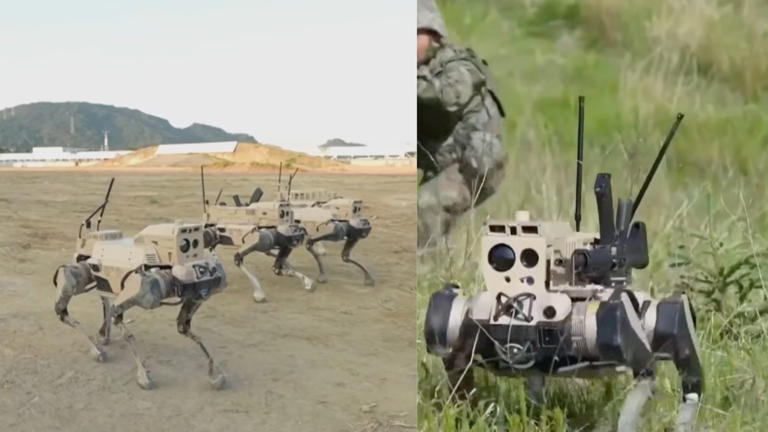
China tests 'wolf robot' assault force, destroys Taiwan's defenses in 10 seconds
Reading the article a few thoughts….
1. It is reported by Chinese media so of course it sounds like a smashing success
2. It didn't destroy defenses in less than 10 seconds. Rather it detects a threat, responds (shoots) and hits the target in under 10 seconds.
3. It is Chinese media so of course it is reported as a smashing success
actually it wasn't. they are bad at defense snd not combat ready. You guys ever think ahead? This is where they are going and they will get it at some point. not everything has repercussions immediately. u guys ever look at trends?
What I do is read a lot, and pay attention to History. China is very good at stealing technology and sometimes reverse engineering, but they suck all at genuine creation.
I mentioned China's abysmal attempt to develop a decent aircraft carrier. They finally got desperate enough to buy the Kuznetsov from Russia when the Russkies gave up on building a second-rate carrier, let alone a blue-water power projection force. The results are not talked about in Beijing.
China has been hungry for decades to be one of the big players, and to that end has bought or stolen every kind of strategic tool, economic as much as military. It's also telling that for all the saber-rattling, Beijing has not launched an invasion of Taiwan. Another scenario we have heard about for decades, but it somehow has not happened, not even when we had a potato in the Oval Office for all practical purposes, and Beijing knew this.
I could go on about the contradictions in China, like trying to build cutting-edge jet fighters at the same time as developing drone swarms that were supposed to make fighters obsolete. My point there is that China does not have a unified plan for their main strategy; they do not even have a single military leader in control of their forces. That is by Xi's intent, to prevent a possible rival for Politburo influence.
Ironically, Xi faced an internal crisis this summer, according to a number of people in IC, and at one point was out of public view for almost two months. It depends on who tells the story whether Xi was ducking enemies or was actually in a kind of house arrest, but almost two dozen senior Chinese military officials died during that time, some being arrested and executed, some dying from odd accidents and four from unexpected heart attacks. If nothing else. the senior military leadership in China is still getting used to their new roles.
Additional concerns about uprisings in Southwest China, a number of accidents along the Mongolian frontier, and unexpected volatility in the stock market also raise questions about China's plans and stability. This is one reason for Xi's recent deals with Putin - he needs to quiet Russian concerns in order to have free hands to work against Trump as much as he can.
There are a lot of moving parts at work, but it should be understood that China is not in control by any rational standard.
you should also know that history is a poor indicator of the future. China was bad at new ideas, the China you describe is the China of 20 to 30 years ago. They are doing pretty good at innovation recently. i see a lot of hubris on this site.
Good point. the last 200yrs of Chinese history is not representative of the whole. Would be more accurate to say they are returning to the mean.
Within that context, though, it is also true that authoritarian regimes tend to not be particularly good at innovation. Yes, they can accomplish things with great nation programs, but that's more a function of spending enough money to move needles. It's hard for dictators to encourage free thinking, experimentation, trial/error exercises in science, technology, business.....and then squelch all that when it comes to public square politics. So can China innovate? Sure. Can they keep pace with us on innovation? No. There's a reason the stealing is mostly "them from us" rather than the other way around.6000 Years of World History in 1 Picture pic.twitter.com/41B5RHPAOJ
— Atlas Press (@realAtlasPress) November 7, 2025
Interesting chart, with some glaring flaws. For instance, the insertion of the USSR into the European column and ignoring Russia's European presence before that. Also, showing Modern India as a follow through of the Mughals instead of the Indus Valley Civilization and completely ignoring the Maratha Empire that overthrew Mughal rule.
It does a nice job of illustrating the cyclical nature of Chinese civilization.
Realitybites said:whiterock said:FLBear5630 said:Oldbear83 said:FLBear5630 said:cowboycwr said:FLBear5630 said:
This is not going to end well...
China tests 'wolf robot' assault force, destroys Taiwan's defenses in 10 seconds
Reading the article a few thoughts….
1. It is reported by Chinese media so of course it sounds like a smashing success
2. It didn't destroy defenses in less than 10 seconds. Rather it detects a threat, responds (shoots) and hits the target in under 10 seconds.
3. It is Chinese media so of course it is reported as a smashing success
actually it wasn't. they are bad at defense snd not combat ready. You guys ever think ahead? This is where they are going and they will get it at some point. not everything has repercussions immediately. u guys ever look at trends?
What I do is read a lot, and pay attention to History. China is very good at stealing technology and sometimes reverse engineering, but they suck all at genuine creation.
I mentioned China's abysmal attempt to develop a decent aircraft carrier. They finally got desperate enough to buy the Kuznetsov from Russia when the Russkies gave up on building a second-rate carrier, let alone a blue-water power projection force. The results are not talked about in Beijing.
China has been hungry for decades to be one of the big players, and to that end has bought or stolen every kind of strategic tool, economic as much as military. It's also telling that for all the saber-rattling, Beijing has not launched an invasion of Taiwan. Another scenario we have heard about for decades, but it somehow has not happened, not even when we had a potato in the Oval Office for all practical purposes, and Beijing knew this.
I could go on about the contradictions in China, like trying to build cutting-edge jet fighters at the same time as developing drone swarms that were supposed to make fighters obsolete. My point there is that China does not have a unified plan for their main strategy; they do not even have a single military leader in control of their forces. That is by Xi's intent, to prevent a possible rival for Politburo influence.
Ironically, Xi faced an internal crisis this summer, according to a number of people in IC, and at one point was out of public view for almost two months. It depends on who tells the story whether Xi was ducking enemies or was actually in a kind of house arrest, but almost two dozen senior Chinese military officials died during that time, some being arrested and executed, some dying from odd accidents and four from unexpected heart attacks. If nothing else. the senior military leadership in China is still getting used to their new roles.
Additional concerns about uprisings in Southwest China, a number of accidents along the Mongolian frontier, and unexpected volatility in the stock market also raise questions about China's plans and stability. This is one reason for Xi's recent deals with Putin - he needs to quiet Russian concerns in order to have free hands to work against Trump as much as he can.
There are a lot of moving parts at work, but it should be understood that China is not in control by any rational standard.
you should also know that history is a poor indicator of the future. China was bad at new ideas, the China you describe is the China of 20 to 30 years ago. They are doing pretty good at innovation recently. i see a lot of hubris on this site.
Good point. the last 200yrs of Chinese history is not representative of the whole. Would be more accurate to say they are returning to the mean.
Within that context, though, it is also true that authoritarian regimes tend to not be particularly good at innovation. Yes, they can accomplish things with great nation programs, but that's more a function of spending enough money to move needles. It's hard for dictators to encourage free thinking, experimentation, trial/error exercises in science, technology, business.....and then squelch all that when it comes to public square politics. So can China innovate? Sure. Can they keep pace with us on innovation? No. There's a reason the stealing is mostly "them from us" rather than the other way around.6000 Years of World History in 1 Picture pic.twitter.com/41B5RHPAOJ
— Atlas Press (@realAtlasPress) November 7, 2025
Interesting chart, with some glaring flaws. For instance, the insertion of the USSR into the European column and ignoring Russia's European presence before that. Also, showing Modern India as a follow through of the Mughals instead of the Indus Valley Civilization and completely ignoring the Maratha Empire that overthrew Mughal rule.
It does a nice job of illustrating the cyclical nature of Chinese civilization.
Check this one out. Remember, the world has never been more than "______" this wide
https://www.visualcapitalist.com/wp-content/uploads/2017/11/histomap-big.html
Albert Einstein; "Life is like riding a bicycle. To keep your balance, you must keep moving"
Assassin said:Realitybites said:whiterock said:FLBear5630 said:Oldbear83 said:FLBear5630 said:cowboycwr said:FLBear5630 said:
This is not going to end well...
China tests 'wolf robot' assault force, destroys Taiwan's defenses in 10 seconds
Reading the article a few thoughts….
1. It is reported by Chinese media so of course it sounds like a smashing success
2. It didn't destroy defenses in less than 10 seconds. Rather it detects a threat, responds (shoots) and hits the target in under 10 seconds.
3. It is Chinese media so of course it is reported as a smashing success
actually it wasn't. they are bad at defense snd not combat ready. You guys ever think ahead? This is where they are going and they will get it at some point. not everything has repercussions immediately. u guys ever look at trends?
What I do is read a lot, and pay attention to History. China is very good at stealing technology and sometimes reverse engineering, but they suck all at genuine creation.
I mentioned China's abysmal attempt to develop a decent aircraft carrier. They finally got desperate enough to buy the Kuznetsov from Russia when the Russkies gave up on building a second-rate carrier, let alone a blue-water power projection force. The results are not talked about in Beijing.
China has been hungry for decades to be one of the big players, and to that end has bought or stolen every kind of strategic tool, economic as much as military. It's also telling that for all the saber-rattling, Beijing has not launched an invasion of Taiwan. Another scenario we have heard about for decades, but it somehow has not happened, not even when we had a potato in the Oval Office for all practical purposes, and Beijing knew this.
I could go on about the contradictions in China, like trying to build cutting-edge jet fighters at the same time as developing drone swarms that were supposed to make fighters obsolete. My point there is that China does not have a unified plan for their main strategy; they do not even have a single military leader in control of their forces. That is by Xi's intent, to prevent a possible rival for Politburo influence.
Ironically, Xi faced an internal crisis this summer, according to a number of people in IC, and at one point was out of public view for almost two months. It depends on who tells the story whether Xi was ducking enemies or was actually in a kind of house arrest, but almost two dozen senior Chinese military officials died during that time, some being arrested and executed, some dying from odd accidents and four from unexpected heart attacks. If nothing else. the senior military leadership in China is still getting used to their new roles.
Additional concerns about uprisings in Southwest China, a number of accidents along the Mongolian frontier, and unexpected volatility in the stock market also raise questions about China's plans and stability. This is one reason for Xi's recent deals with Putin - he needs to quiet Russian concerns in order to have free hands to work against Trump as much as he can.
There are a lot of moving parts at work, but it should be understood that China is not in control by any rational standard.
you should also know that history is a poor indicator of the future. China was bad at new ideas, the China you describe is the China of 20 to 30 years ago. They are doing pretty good at innovation recently. i see a lot of hubris on this site.
Good point. the last 200yrs of Chinese history is not representative of the whole. Would be more accurate to say they are returning to the mean.
Within that context, though, it is also true that authoritarian regimes tend to not be particularly good at innovation. Yes, they can accomplish things with great nation programs, but that's more a function of spending enough money to move needles. It's hard for dictators to encourage free thinking, experimentation, trial/error exercises in science, technology, business.....and then squelch all that when it comes to public square politics. So can China innovate? Sure. Can they keep pace with us on innovation? No. There's a reason the stealing is mostly "them from us" rather than the other way around.6000 Years of World History in 1 Picture pic.twitter.com/41B5RHPAOJ
— Atlas Press (@realAtlasPress) November 7, 2025
Interesting chart, with some glaring flaws. For instance, the insertion of the USSR into the European column and ignoring Russia's European presence before that. Also, showing Modern India as a follow through of the Mughals instead of the Indus Valley Civilization and completely ignoring the Maratha Empire that overthrew Mughal rule.
It does a nice job of illustrating the cyclical nature of Chinese civilization.
Check this one out. Remember, the world has never been more than "______" this wide
https://www.visualcapitalist.com/wp-content/uploads/2017/11/histomap-big.html
Now that's a good chart.
Realitybites said:Assassin said:Realitybites said:whiterock said:FLBear5630 said:Oldbear83 said:FLBear5630 said:cowboycwr said:FLBear5630 said:
This is not going to end well...
China tests 'wolf robot' assault force, destroys Taiwan's defenses in 10 seconds
Reading the article a few thoughts….
1. It is reported by Chinese media so of course it sounds like a smashing success
2. It didn't destroy defenses in less than 10 seconds. Rather it detects a threat, responds (shoots) and hits the target in under 10 seconds.
3. It is Chinese media so of course it is reported as a smashing success
actually it wasn't. they are bad at defense snd not combat ready. You guys ever think ahead? This is where they are going and they will get it at some point. not everything has repercussions immediately. u guys ever look at trends?
What I do is read a lot, and pay attention to History. China is very good at stealing technology and sometimes reverse engineering, but they suck all at genuine creation.
I mentioned China's abysmal attempt to develop a decent aircraft carrier. They finally got desperate enough to buy the Kuznetsov from Russia when the Russkies gave up on building a second-rate carrier, let alone a blue-water power projection force. The results are not talked about in Beijing.
China has been hungry for decades to be one of the big players, and to that end has bought or stolen every kind of strategic tool, economic as much as military. It's also telling that for all the saber-rattling, Beijing has not launched an invasion of Taiwan. Another scenario we have heard about for decades, but it somehow has not happened, not even when we had a potato in the Oval Office for all practical purposes, and Beijing knew this.
I could go on about the contradictions in China, like trying to build cutting-edge jet fighters at the same time as developing drone swarms that were supposed to make fighters obsolete. My point there is that China does not have a unified plan for their main strategy; they do not even have a single military leader in control of their forces. That is by Xi's intent, to prevent a possible rival for Politburo influence.
Ironically, Xi faced an internal crisis this summer, according to a number of people in IC, and at one point was out of public view for almost two months. It depends on who tells the story whether Xi was ducking enemies or was actually in a kind of house arrest, but almost two dozen senior Chinese military officials died during that time, some being arrested and executed, some dying from odd accidents and four from unexpected heart attacks. If nothing else. the senior military leadership in China is still getting used to their new roles.
Additional concerns about uprisings in Southwest China, a number of accidents along the Mongolian frontier, and unexpected volatility in the stock market also raise questions about China's plans and stability. This is one reason for Xi's recent deals with Putin - he needs to quiet Russian concerns in order to have free hands to work against Trump as much as he can.
There are a lot of moving parts at work, but it should be understood that China is not in control by any rational standard.
you should also know that history is a poor indicator of the future. China was bad at new ideas, the China you describe is the China of 20 to 30 years ago. They are doing pretty good at innovation recently. i see a lot of hubris on this site.
Good point. the last 200yrs of Chinese history is not representative of the whole. Would be more accurate to say they are returning to the mean.
Within that context, though, it is also true that authoritarian regimes tend to not be particularly good at innovation. Yes, they can accomplish things with great nation programs, but that's more a function of spending enough money to move needles. It's hard for dictators to encourage free thinking, experimentation, trial/error exercises in science, technology, business.....and then squelch all that when it comes to public square politics. So can China innovate? Sure. Can they keep pace with us on innovation? No. There's a reason the stealing is mostly "them from us" rather than the other way around.6000 Years of World History in 1 Picture pic.twitter.com/41B5RHPAOJ
— Atlas Press (@realAtlasPress) November 7, 2025
Interesting chart, with some glaring flaws. For instance, the insertion of the USSR into the European column and ignoring Russia's European presence before that. Also, showing Modern India as a follow through of the Mughals instead of the Indus Valley Civilization and completely ignoring the Maratha Empire that overthrew Mughal rule.
It does a nice job of illustrating the cyclical nature of Chinese civilization.
Check this one out. Remember, the world has never been more than "______" this wide
https://www.visualcapitalist.com/wp-content/uploads/2017/11/histomap-big.html
Now that's a good chart.
Easier to understand than the lava lamp one in the other post, I still dont quite comprehend it.
Albert Einstein; "Life is like riding a bicycle. To keep your balance, you must keep moving"
Kevin Hassett: "I think there could be a little bit of an almost quiet time in the labor market, because firms are finding that AI is making their workers so productive that they don't necessarily have to hire the new kids out of college and so on." pic.twitter.com/ma8iwhiGsk
— Aaron Rupar (@atrupar) November 17, 2025
If it is obvious to everyone that entry level white collar jobs (programmers, financial services, etc) are going away, why are we still importing H-1B visa migrants? 80% of H-1B visas go to "entry/junior" level white collar jobs.
— Wall Street Mav (@WallStreetMav) November 17, 2025
"AI could wipe out half of all entry level white… pic.twitter.com/kQfIOtKXjf
Realitybites said:whiterock said:FLBear5630 said:Oldbear83 said:FLBear5630 said:cowboycwr said:FLBear5630 said:
This is not going to end well...
China tests 'wolf robot' assault force, destroys Taiwan's defenses in 10 seconds
Reading the article a few thoughts….
1. It is reported by Chinese media so of course it sounds like a smashing success
2. It didn't destroy defenses in less than 10 seconds. Rather it detects a threat, responds (shoots) and hits the target in under 10 seconds.
3. It is Chinese media so of course it is reported as a smashing success
actually it wasn't. they are bad at defense snd not combat ready. You guys ever think ahead? This is where they are going and they will get it at some point. not everything has repercussions immediately. u guys ever look at trends?
What I do is read a lot, and pay attention to History. China is very good at stealing technology and sometimes reverse engineering, but they suck all at genuine creation.
I mentioned China's abysmal attempt to develop a decent aircraft carrier. They finally got desperate enough to buy the Kuznetsov from Russia when the Russkies gave up on building a second-rate carrier, let alone a blue-water power projection force. The results are not talked about in Beijing.
China has been hungry for decades to be one of the big players, and to that end has bought or stolen every kind of strategic tool, economic as much as military. It's also telling that for all the saber-rattling, Beijing has not launched an invasion of Taiwan. Another scenario we have heard about for decades, but it somehow has not happened, not even when we had a potato in the Oval Office for all practical purposes, and Beijing knew this.
I could go on about the contradictions in China, like trying to build cutting-edge jet fighters at the same time as developing drone swarms that were supposed to make fighters obsolete. My point there is that China does not have a unified plan for their main strategy; they do not even have a single military leader in control of their forces. That is by Xi's intent, to prevent a possible rival for Politburo influence.
Ironically, Xi faced an internal crisis this summer, according to a number of people in IC, and at one point was out of public view for almost two months. It depends on who tells the story whether Xi was ducking enemies or was actually in a kind of house arrest, but almost two dozen senior Chinese military officials died during that time, some being arrested and executed, some dying from odd accidents and four from unexpected heart attacks. If nothing else. the senior military leadership in China is still getting used to their new roles.
Additional concerns about uprisings in Southwest China, a number of accidents along the Mongolian frontier, and unexpected volatility in the stock market also raise questions about China's plans and stability. This is one reason for Xi's recent deals with Putin - he needs to quiet Russian concerns in order to have free hands to work against Trump as much as he can.
There are a lot of moving parts at work, but it should be understood that China is not in control by any rational standard.
you should also know that history is a poor indicator of the future. China was bad at new ideas, the China you describe is the China of 20 to 30 years ago. They are doing pretty good at innovation recently. i see a lot of hubris on this site.
Good point. the last 200yrs of Chinese history is not representative of the whole. Would be more accurate to say they are returning to the mean.
Within that context, though, it is also true that authoritarian regimes tend to not be particularly good at innovation. Yes, they can accomplish things with great nation programs, but that's more a function of spending enough money to move needles. It's hard for dictators to encourage free thinking, experimentation, trial/error exercises in science, technology, business.....and then squelch all that when it comes to public square politics. So can China innovate? Sure. Can they keep pace with us on innovation? No. There's a reason the stealing is mostly "them from us" rather than the other way around.6000 Years of World History in 1 Picture pic.twitter.com/41B5RHPAOJ
— Atlas Press (@realAtlasPress) November 7, 2025
Interesting chart, with some glaring flaws. For instance, the insertion of the USSR into the European column and ignoring Russia's European presence before that. Also, showing Modern India as a follow through of the Mughals instead of the Indus Valley Civilization and completely ignoring the Maratha Empire that overthrew Mughal rule.
It does a nice job of illustrating the cyclical nature of Chinese civilization.
No other place for the USSR than in the European column. Thought most of its territory was in Asia…most of its population and big cities were in Europe
[Approximately 72% of the Soviet Union's population lived in its European part, which constituted about one-quarter of the USSR's total land area. This European portion included the most densely populated areas and was concentrated roughly between the Dnieper River and the Ural Mountains. The European region was also the core of the country's industrial and agricultural activity. ]
“It has come to our attention that your personal information and conversation histories with AI “Jesus” have been exposed in a recent data breach….” pic.twitter.com/4JgO8inAjw
— Tegridy (@Chelsea_UpNorth) November 15, 2025
boognish_bear said:“It has come to our attention that your personal information and conversation histories with AI “Jesus” have been exposed in a recent data breach….” pic.twitter.com/4JgO8inAjw
— Tegridy (@Chelsea_UpNorth) November 15, 2025
Some churches losing their way.
AI could help in a lot of ways in a church, but that's not one of them. I guess that's what happens when Elmo gets ordained.
boognish_bear said:
Ai and robot use in the military brings up another ethical angle...it's when it feels like we started getting into Terminator territory.Crewed aircraft will be destroyed instantly by cheap drone swarms https://t.co/7tCC8CKKaD
— Elon Musk (@elonmusk) April 26, 2025
It's worth clicking through to that X post and reading the whole thing as it sheds a lot of light on how the military industrial complex works.
I see poverty as more of an engineering problem than an unsolvable social issue. With Grok and Optimus, we could solve the labor shortage, drive costs to near zero, and create a future where poverty is statistically irrelevant.
— TΞTSUØ (@tetsuoai) November 19, 2025
The scale of whats coming over the next decade is… pic.twitter.com/2cvGb5shBw
boognish_bear said:I see poverty as more of an engineering problem than an unsolvable social issue. With Grok and Optimus, we could solve the labor shortage, drive costs to near zero, and create a future where poverty is statistically irrelevant.
— TΞTSUØ (@tetsuoai) November 19, 2025
The scale of whats coming over the next decade is… pic.twitter.com/2cvGb5shBw
That would depend on a LOT of things going juuust right to get products to near zero and not crash a society and economy.
“Want to make people laugh at a party Use Grok’s unhinged mode for an epic roast.” — Elon Musk pic.twitter.com/D7SOpJC3sm
— Tesla Owners Silicon Valley (@teslaownersSV) November 1, 2025
boognish_bear said:I see poverty as more of an engineering problem than an unsolvable social issue. With Grok and Optimus, we could solve the labor shortage, drive costs to near zero, and create a future where poverty is statistically irrelevant.
— TΞTSUØ (@tetsuoai) November 19, 2025
The scale of whats coming over the next decade is… pic.twitter.com/2cvGb5shBw
Unfortunately, this sort of utopianism will never work.
(1) Near zero production costs do not equal zero production costs.
(2) Even if you say that you're going to print and distribute a UBI so that those production costs are covered, how do you distribute any number of limited access assets that exist in this world (ie beach front single family homes)?
I'm sure his intentions are good, but it ignores economic realities that have existed since the dawn of time.
Realitybites said:boognish_bear said:I see poverty as more of an engineering problem than an unsolvable social issue. With Grok and Optimus, we could solve the labor shortage, drive costs to near zero, and create a future where poverty is statistically irrelevant.
— TΞTSUØ (@tetsuoai) November 19, 2025
The scale of whats coming over the next decade is… pic.twitter.com/2cvGb5shBw
Unfortunately, this sort of utopianism will never work.
(1) Near zero production costs do not equal zero production costs.
(2) Even if you say that you're going to print and distribute a UBI so that those production costs are covered, how do you distribute any number of limited access assets that exist in this world (ie beach front single family homes)?
I'm sure his intentions are good, but it ignores economic realities that have existed since the dawn of time.
UBI proposes to return us to feudalism.
whiterock said:Realitybites said:boognish_bear said:I see poverty as more of an engineering problem than an unsolvable social issue. With Grok and Optimus, we could solve the labor shortage, drive costs to near zero, and create a future where poverty is statistically irrelevant.
— TΞTSUØ (@tetsuoai) November 19, 2025
The scale of whats coming over the next decade is… pic.twitter.com/2cvGb5shBw
Unfortunately, this sort of utopianism will never work.
(1) Near zero production costs do not equal zero production costs.
(2) Even if you say that you're going to print and distribute a UBI so that those production costs are covered, how do you distribute any number of limited access assets that exist in this world (ie beach front single family homes)?
I'm sure his intentions are good, but it ignores economic realities that have existed since the dawn of time.
UBI proposes to return us to feudalism.
That is precisely what will happen.
Unfortunately, that is also the final destination of a capitalist system overtaken by monopolies, oligopolies, and financialization. If 51% of the people come to the conclusion that the feudalism offered by socialism and a UBI is better for their personal situation we are going to have a real problem.
Realitybites said:whiterock said:Realitybites said:boognish_bear said:I see poverty as more of an engineering problem than an unsolvable social issue. With Grok and Optimus, we could solve the labor shortage, drive costs to near zero, and create a future where poverty is statistically irrelevant.
— TΞTSUØ (@tetsuoai) November 19, 2025
The scale of whats coming over the next decade is… pic.twitter.com/2cvGb5shBw
Unfortunately, this sort of utopianism will never work.
(1) Near zero production costs do not equal zero production costs.
(2) Even if you say that you're going to print and distribute a UBI so that those production costs are covered, how do you distribute any number of limited access assets that exist in this world (ie beach front single family homes)?
I'm sure his intentions are good, but it ignores economic realities that have existed since the dawn of time.
UBI proposes to return us to feudalism.
That is precisely what will happen.
Unfortunately, that is also the final destination of a capitalist system overtaken by monopolies, oligopolies, and financialization. If 51% of the people come to the conclusion that the feudalism offered by socialism and a UBI is better for their personal situation we are going to have a real problem.
It's not inevitable and it won't happen overnight. Will take decades. During which time we have choices to make.
I think the central question is going to quickly become: how are we going to tax "data?"
Realitybites said:boognish_bear said:I see poverty as more of an engineering problem than an unsolvable social issue. With Grok and Optimus, we could solve the labor shortage, drive costs to near zero, and create a future where poverty is statistically irrelevant.
— TΞTSUØ (@tetsuoai) November 19, 2025
The scale of whats coming over the next decade is… pic.twitter.com/2cvGb5shBw
Unfortunately, this sort of utopianism will never work.
(1) Near zero production costs do not equal zero production costs.
(2) Even if you say that you're going to print and distribute a UBI so that those production costs are covered, how do you distribute any number of limited access assets that exist in this world (ie beach front single family homes)?
I'm sure his intentions are good, but it ignores economic realities that have existed since the dawn of time.
Not to mention maintenance of units. Hardware, Firmware and Software alone will challenge most employers.
whiterock said:Realitybites said:whiterock said:Realitybites said:boognish_bear said:I see poverty as more of an engineering problem than an unsolvable social issue. With Grok and Optimus, we could solve the labor shortage, drive costs to near zero, and create a future where poverty is statistically irrelevant.
— TΞTSUØ (@tetsuoai) November 19, 2025
The scale of whats coming over the next decade is… pic.twitter.com/2cvGb5shBw
Unfortunately, this sort of utopianism will never work.
(1) Near zero production costs do not equal zero production costs.
(2) Even if you say that you're going to print and distribute a UBI so that those production costs are covered, how do you distribute any number of limited access assets that exist in this world (ie beach front single family homes)?
I'm sure his intentions are good, but it ignores economic realities that have existed since the dawn of time.
UBI proposes to return us to feudalism.
That is precisely what will happen.
Unfortunately, that is also the final destination of a capitalist system overtaken by monopolies, oligopolies, and financialization. If 51% of the people come to the conclusion that the feudalism offered by socialism and a UBI is better for their personal situation we are going to have a real problem.
It's not inevitable and it won't happen overnight. Will take decades. During which time we have choices to make.
I think the central question is going to quickly become: how are we going to tax "data?"
Who owns it? Data will attract a VAT type tax, with each change, analyses and manipulation to make it usable creates a different value. That is one of the things people do not talk about or overlook, data by itself is useless and meaningless. It takes the analytics and context to create value. Right now, data and analytic costs are more than many organizations are willing to spend.
if you get kicked out of school for this you can sue btw
— Steve the Beaver (@beaversteever) November 24, 2025
Jeez dude... stop saying the truth out loud!
— Financelot (@FinanceLancelot) November 24, 2025
People aren't supposed to know this yet 🤫 https://t.co/UXYFMzgbd3 pic.twitter.com/lYE8GPbVm3
Solving the power problem is the long term hurdle of advanced Ai and broad adoption. The short term problem is trust and monetization. As a simple example, the much ballyhooed use of robotics and automation in auto manufacturing hasn't been the boon it was projected to facilitate, and in fact margins over the last 10 years have declined and the future looks flat at best even as technology advances. This plagues even more modern entrants such as Tesla. These type of economic realities belie the theory of a "low or zero" cost future.
NEW: Bannon tells ABC News he's warning that Trump admin's AI agenda could “crush the working class,” fracture MAGA, and cost GOP in 26 & 28
— Will Steakin (@wsteaks) November 24, 2025
He's working to “turbo-charge” the base to revolt against it
Inside MAGA’s fight to stop the AI revolution:https://t.co/csd4LF4qDN
boognish_bear said:NEW: Bannon tells ABC News he's warning that Trump admin's AI agenda could “crush the working class,” fracture MAGA, and cost GOP in 26 & 28
— Will Steakin (@wsteaks) November 24, 2025
He's working to “turbo-charge” the base to revolt against it
Inside MAGA’s fight to stop the AI revolution:https://t.co/csd4LF4qDN
I can't believe I am saying this, but I agree with Bannon on this one. There are no rainbows for the lower 90% of the world in this AI move.
Hey, Harrison! Bannon is agreeing with me on AI. Is it now a correct opinion???
ATL Bear said:
Solving the power problem is the long term hurdle of advanced Ai and broad adoption. The short term problem is trust and monetization. As a simple example, the much ballyhooed use of robotics and automation in auto manufacturing hasn't been the boon it was projected to facilitate, and in fact margins over the last 10 years have declined and the future looks flat at best even as technology advances. This plagues even more modern entrants such as Tesla. These type of economic realities belie the theory of a "low or zero" cost future.
Not only that, but they are costing the general market out of their product. All this great tech and automated production has driven the average cost of a vehicle to 50k. Cost of housing is at record highs.
Recent personal experience, we were going to trade in my truck, walked out when they showed us the finance terms, we will keep what we have paid off. I am not exactly a Dave Ramsey disciple, I would say I am more on the cash flow side of the equation than the pay cash for everything. If I am not interested in it, then there will be about 60% of the population that won't even go in the door.
This is where misguided policy is failing us. We're focused on bringing jobs back around manufacturing. We are falling further behind in the type of advanced manufacturing that does create efficiencies and massive production gains. From a recent WSJ article:FLBear5630 said:ATL Bear said:
Solving the power problem is the long term hurdle of advanced Ai and broad adoption. The short term problem is trust and monetization. As a simple example, the much ballyhooed use of robotics and automation in auto manufacturing hasn't been the boon it was projected to facilitate, and in fact margins over the last 10 years have declined and the future looks flat at best even as technology advances. This plagues even more modern entrants such as Tesla. These type of economic realities belie the theory of a "low or zero" cost future.
Not only that, but they are costing the general market out of their product. All this great tech and automated production has driven the average cost of a vehicle to 50k. Cost of housing is at record highs.
Recent personal experience, we were going to trade in my truck, walked out when they showed us the finance terms, we will keep what we have paid off. I am not exactly a Dave Ramsey disciple, I would say I am more on the cash flow side of the equation than the pay cash for everything. If I am not interested in it, then there will be about 60% of the population that won't even go in the door.
https://www.wsj.com/tech/ai/ai-robots-china-manufacturing-89ae1b42?st=Bmuv3h&reflink=article_copyURL_share
" China installed 295,000 industrial robots last year, nearly nine times as many as the U.S. and more than the rest of the world combined, according to the International Federation of Robotics. China's stock of operational robots surpassed two million in 2024, the most of any country.
Of 131 factories and industrial sites recognized by the World Economic Forum globally for lifting productivity through cutting edge technologies such as AI, 45 are in mainland China, while three are in the U.S."
We are over regulated and burdened by legacy perspectives of labor and manufacturing while China and other countries are moving quickly toward the technology focused production models of the future.
ATL Bear said:FLBear5630 said:ATL Bear said:
Solving the power problem is the long term hurdle of advanced Ai and broad adoption. The short term problem is trust and monetization. As a simple example, the much ballyhooed use of robotics and automation in auto manufacturing hasn't been the boon it was projected to facilitate, and in fact margins over the last 10 years have declined and the future looks flat at best even as technology advances. This plagues even more modern entrants such as Tesla. These type of economic realities belie the theory of a "low or zero" cost future.
Not only that, but they are costing the general market out of their product. All this great tech and automated production has driven the average cost of a vehicle to 50k. Cost of housing is at record highs.
Recent personal experience, we were going to trade in my truck, walked out when they showed us the finance terms, we will keep what we have paid off. I am not exactly a Dave Ramsey disciple, I would say I am more on the cash flow side of the equation than the pay cash for everything. If I am not interested in it, then there will be about 60% of the population that won't even go in the door.
This is where misguided policy is failing us. We're focused on bringing jobs back around manufacturing. We are falling further behind in the type of advanced manufacturing that does create efficiencies and massive production gains. From a recent WSJ article:
https://www.wsj.com/tech/ai/ai-robots-china-manufacturing-89ae1b42?st=Bmuv3h&reflink=article_copyURL_share
" China installed 295,000 industrial robots last year, nearly nine times as many as the U.S. and more than the rest of the world combined, according to the International Federation of Robotics. China's stock of operational robots surpassed two million in 2024, the most of any country.
Of 131 factories and industrial sites recognized by the World Economic Forum globally for lifting productivity through cutting edge technologies such as AI, 45 are in mainland China, while three are in the U.S."
We are over regulated and burdened by legacy perspectives of labor and manufacturing while China and other countries are moving quickly toward the technology focused production models of the future.
They put more emphasis on education. We are stuck on the concept of a HS diploma and a job on the line can raise a family of 5 in a nice area and have a house, 2 cars, etc...
We are saying advanced education is not worth it, some on hear are saying Dems caused too many to go to school and get degrees. They should be plumbers and vo-tech. So they can work for the Chinese and Taiwanese kids that actually use their degrees. Too many advanced degrees is not the problem.
Providing special treatment (regulatory moratoriums, tax abatements, zoning preferences) for AI companies is bad policy on its face, but it is particularly absurd when its proponents are predicting massive unemployment as a result. https://t.co/C1yOpgaBU3
— Ron DeSantis (@RonDeSantis) November 25, 2025
It's like AI has a gun to our head now… We are damned if we do and we're damned if we don't
BREAKING: Without continued AI investments, U.S. GDP growth would collapse in half.
— Polymarket (@Polymarket) November 25, 2025
JUST IN - Trump signs "Genesis Mission" executive order to build an "integrated AI platform" with access to "Federal scientific datasets" to dramatically accelerate AI development "comparable in urgency and ambition to the Manhattan Project" that developed nuclear weapons. pic.twitter.com/BkGUZDyoq6
— Disclose.tv (@disclosetv) November 24, 2025
I guess the old threat to kids about you better take school seriously or you are going to be flipping burgers is going to need to be updated…
I thought we had more time before AI and robotics took over fast food…
— Financial Dystopia (@financedystop) November 24, 2025
But this machine can make an entire burger, start to finish, without a single human involved. pic.twitter.com/oA6Z2mgwyc
Sounds like it's gonna be a real challenge to keep feeding these machines
Wright: We will take backup generators already at data centers or behind the back of a Walmart and bring those on when we need extra electricity production pic.twitter.com/ppCQJ6v37q
— Acyn (@Acyn) November 24, 2025
boognish_bear said:
Sounds like it's gonna be a real challenge to keep feeding these machinesWright: We will take backup generators already at data centers or behind the back of a Walmart and bring those on when we need extra electricity production pic.twitter.com/ppCQJ6v37q
— Acyn (@Acyn) November 24, 2025
Is what we are gaining worth it? What is the ROI on the AI and robotics for a burger making machine?